
Spiders and ants are the two big predators of the insect world. But did you know that there are some spiders that mimic ants to protect themselves from predators and to fool their prey? In this blog, we look at some of these unique spiders.
If you have ever watched the popular Netflix series Money Heist, you would know about the robber’s incredibly effective strategy to wear masks that look exactly like the ones that the hostages were wearing.
Using this mimicry, they were able to confuse the authorities and execute the robbery without any major casualties. Pretty smart, eh?
But what if we told you that the idea of mimicry is millions of years old, and even the lowly spiders beneath your feet have been using it effectively?
That’s right, spiders have been copying other insects to avoid predators, and one of the main insects that they mimic is the humble but powerful ant.

In this article, we look at 20 examples of spiders around the world that have been copying ants. But before we begin, here is a brief background on mimicry in the insect world.
What is Mimicry?
Mimicry is exactly what the word suggests – one creature copying the characteristics of another one. The point of doing this is simple – predators often perceive the world around them by sight, sound, and smell.
If an organism is able to present itself as dangerous prey to its predators, then its chances of surviving in the wild increase dramatically.
Over millions of years of evolution, many organisms in the world, including common insects and smaller mammals, have adapted mimicry as a defense strategy.
Types of Mimicry in the Insect World
You might think that mimicry seems pretty straightforward, but that’s not the case. There are many types of mimicry and many end purposes also.
Some forms of mimicry are purely for defensive purposes, while others are aggressive, and a few others are reproductive in nature.
Aggressive mimicry is the reverse of what you would normally think – its predators copy prey to make them appear harmless.
Reproductive mimicry is more often shown by plants whose flowers copy the features of other plants that are rewarding so as to attract insects to pollinate themselves.
However, the most common form and most widely researched form of mimicry remains defensive. Within this, there are several types, as explained in the table below.
| Type of Mimicry | Description |
| Batesian mimicry | A harmless organism poses like a harmful one |
| Müllerian mimicry | Two species that are harmful pose as each other. |
| Emsleyan/Mertensian mimicry | A deadly creature mimics a less harmful one so that the predator learns a lesson from biting the less harmful creature. |
| Wasmannian | Mimicking a creature that the mimic lives near or with |
| Vavilovian | Weeds that look like domesticated plants |
| Gilbertian | Possible host mimic a parasite to drive it away |
| Browerian | Less dangerous insect mimics more dangerous one from the same species |
Do you want to know the secret to transform your backyard into a haven for birds and butterflies? If so, then check this course out!
Why Should Spiders Mimic Ants? Aren’t They Just as Deadly and Venomous to Boot?
Yes, spiders are venomous. And they are known to give painful bites to all those who approach them. But that doesn’t mean that they are the most successful defenders in the world.
As per fossil dating, the oldest ants have been around since 99 million years ago, and scientists suggest that this duration could be much longer.
So what has helped them live for so long in a cruel and unyielding world that eliminated huge creatures such as dinosaurs and the wooly mammoth?
There are four things that they have worked on, which most other insects have failed to do:
- Organize themselves into colonies in resource-rich areas
- Create a role-based system with clear and defined work for each ant
- Evolved features necessary to perform their respective roles.
- Learned to attack in groups rather than fight alone.
Ants realized eons ago that the best strategy to survive in this world is to get organized. They created a hierarchy-based system with a solitary queen, workers, soldiers, and males (whose only job was to procreate and die).
Each ant has developed specialized tools to do its job properly. For example, soldier ants have strong jaws that let them bite predators and stingers that can spray formic acid on them.

But Why Do Spiders Need To Mimic Them?
For one thing, many spiders are still solitary, so despite their venom, they are not as effective in warding off prospective predators.
Moreover, spiders realize that ants are excellent foragers and hunters. This makes it a good idea to copy them in order to attack their prey and eat them.
There are nearly 45,000 species of spiders in the world, and more than 300 of them have resorted to ant mimicry to get things done.
It is not just that they look like ants – some of these spiders actually behave like them (perhaps they have a split personality disorder!)
Some of them wave their front legs so that they look like they have antennae, while others walk in a zig-zag pattern, just like ants searching for a pheromone trail.
Mimicry of Ant in Spiders
While copying their looks is an obvious trait of mimicry, there are certain other behaviors and features that spiders have evolved to ensure that they look as close to ants as possible.
For example, many ant-mimicking spiders raise their two front legs, making them look like antennae. This can easily confuse any predator that is looking at the spider from the front since it seems like a six-legged ant is approaching.
Scientists used to think that these spiders simply never use their front legs, but recent research has shown that they do.
In fact, these spiders make brief pauses while moving, long enough for predators to see their raised legs, and then put down the legs and use them to walk just like other spiders.

Other characteristic features include a thread-waisted body that looks like it has three segments, spots on the head that look like ant eyes, and a zig-zag walk that appears almost that of an ant searching for pheromones to guide her.
Some spiders even live near ant nests, rubbing their formic acid on themselves to mimic their smell and deter predators.
It is pertinent to note here that not all ant mimic spiders use all tactics. Most use only 1-2 of these features (the leg-raising thing is perhaps the most common).
As long as predators are getting fooled, the spiders don’t seem to care!
Ant -Like Crab Spider (Amyciaea forticeps)
Found primarily in the Amazon rainforests, ant-mimicking crab spiders have evolved several unique adaptations that make them look like weaver ants.
For one thing, these spiders beautiful disguise their eight legs (as opposed to the six of the ant) by lifting up their front two legs in a sort of waving motion, almost as if they were antennae.
Another interesting feature is the fake spots on the front of the mouth, which look like the eyes of the ant.
Males look like they are carrying another ant in their mouth, but this second ant is actually a sword-like jaw, which they use to fight predators and also to impress the females.

Crab spiders look and dance like (you guessed it) crabs. They even walk sideways like crabs.
But when they are fighting, they bring in all these mimicry features to make them appear like ants.
They don’t go after the prey, appearing to wait for it until it comes in front of them. They then use the front two legs (which they were waving around like antennae) to grab their prey
These spiders usually live in trees and make their home near the nests of their model ants. But one thing that clearly differentiates them is their ability to jump – no ant can jump like a spider can.
If they ever attack the ants themselves, they let themselves fall, hanging on by a silk strand. The poor fighting ant has no chance to call its mate and eventually dies of the venom in the spider’s sting.
Here’s a video of these amazing creatures.
Red Weaver Ant-mimicking Spider (Myrmaplata plataleoides)
Also known as the Karenga ant-like jumper, this is another species of spider that mimic weaver ants, with almost similar characteristics as that of the ant-like crab spider.
These spiders have orangish bodies, a thin and narrow waist, spots on the abdomen that look like eyes and raise their front legs like antennae.
In short, they do everything in their power to look like weaver ants.
It makes a lot of sense for these spiders to mimic ants because neither is their venom very powerful nor are they fierce biters.
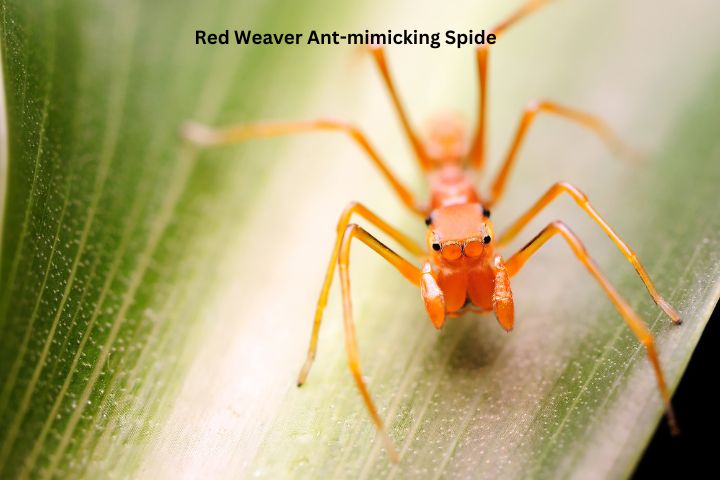
These spiders live in trees near their model ants colonies and even go near the nest to get the ant-like smell on themselves to fool predators.
However, unlike the ant-like crab spiders, the Karenga jumpers do not hunt ants directly. They weave a light web and wait for prey to fall into it on its own.
The video below shows the similarities between this species and their model weaver ants.
Two-banded Ant-mimic Sac Spider (Castianeira cingulata)
So, rather than explain to you how this spider imitates an ant, let’s just show you a video instead:
This tiny spider does everything in its might to replicate the look of an ant, including a dark, long body, and thin, thread-like waist.
From afar, there is hardly anything that can help you tell the difference, but when you look up close, you will find the two telltale extra legs that a spider has.
There is one more identification marker of this spider that becomes visible as it grows slightly older. It has two light brown bands on its body, which are often quite hard to see from a distance but can be visible when you come up close.

Common Patterned Ant-mimic Ground Spider (Sergiolus montanus)
After covering weaver ants, let us now move to spiders that mimic velvet ants.
The Common patterned ant mimic is a brightly colored spider that tries to imitate the looks of a velvet ant. It is hairy and comes in several varieties of colors.
These spiders are found in wooded areas where they can hide under tree bark and leaves. They are wanderers, but they do build a nest to lay eggs.
These spiders are hunters; they are not the kind that builds webs to catch their prey. They use their strong stingers and mouthparts to disable their prey.
Velvet ants are known for their powerful stings in the insect world, so mimicking them is an effective strategy that wards off many predators in the wild.
Here’s a video of a patterned ground spider foraging around in some trash:
Orange Ant-mimic Sac Spider (Castianeira amoena)
As the name suggests, this is a bright orange colored spider that mimics velvet ants of the same color.
Velvet ants are actually wingless wasps, but the name ants has stuck to them because of their appearance and the fact they don’t have wings.

The Orange ant mimic spider gains from the fear that velvet ants have generated due to their powerful and venomous stingers.
Myrmarachne Formicaria
The Myrmarachne Formicaria is a jumping spider commonly found in the tropics, with a very close resemblance to wood ants.
These spiders usually grow to about 1/5th of an inch and show many characteristics of an ant, such as walking in a zig-zag pattern, raising their legs in the air when they pause (to mimic antennae), and of course, their brownish black color.
In the United States, these spiders can often be seen during the summer months. They love to inhabit homes as well as open spaces like gardens

Jumping spiders, like the Myrmarachne Formicaria are part of a large set of nearly 6,000 described species of spiders, who all show the ability to jump long distances.
They have a unique way of propelling themselves very high. Unlike grasshoppers (which have strong hind legs) or springtails (which use an appendage known as furcula), these spiders can channel a large amount of blood to their rear legs when they need to jump.
This sudden rush of blood expands their legs and lets them jump like a spring action. Jumping spiders can travel distances almost forty times their body lengths using this method.
They use this ability to catch their prey off guard and sting them easily.
Greater Ant-mimic Corinne Spider (Phrurotimpus borealis)
A spider native to America, the greater ant-mimic Corinne does not actually resemble an ant very much. However, it is able to mimic the behavior of ants to grab its prey.
The spider is brown to metallic black in color and has a big abdomen. It comes from the family Phrurolithidae.
The spider raises its first leg to mimic the motion of antennae and also walks in a somewhat random fashion as if searching for a trail.
Bicolor Ant-mimic Jumping Spider (Myrmarachne melanocephala)
While this beautiful species of jumping spider does not closely resemble an ant from up close, some of its features resemble that of ants from afar.
It might look like an ant to a predator who is looking at it from above. This spider can jump long distances and also hunts other ants.
Its orange and black color is somewhat similar to that of the strobe ant, and it moves fast, just like the ant does.
It is also believed that this spider can produce odors similar to the ants’ pheromones, which helps it hunt ants by luring them near.
https://youtube.com/shorts/Hnu282Pyckw?feature=share
Japanese Ant-mimic Spider (Myrmarachne japonica)
As you must have guessed by now, many of these spiders are from the family Myrmarachne. This is a species of jumping spiders that all mimic ants and move like them.
While some of the species only have a passing resemblance to their models, the Japanese ant mimic is very much like an ant. Just watch it in the video below.
Their bodies are adapted in a way that makes them look three-segmented, resembling ants.
Moreover, it is jet black in color and lifts its legs in the air to mimic antennae, just like ants. The presence of large forward-facing eyes is one of the things that give away the fact that this is actually a spider, not an ant.

One interesting tidbit about jumping spiders is that they have excellent eyesight. They are able to stalk their prey from afar and then use their jumping tactic to grab them quickly.
Variegated Ant-mimic Sac Spider (Castianeira variata)
The variegated ant mimic spider is a reddish brown insect that looks very much similar to C. Longipalpus ( a kind of beetle).
They are found all over Central and North America and are smallish creatures with a length of about 0.3-0.35 inch length.
This is another species of spider that doesn’t look much like an ant but certainly behaves like one to ensure that predators are left in doubt.
This species also tries to live near anthills so that they can confuse any predators they might have.
Red-spotted Ant-mimic Sac Spider (Castianeira descripta)
The red-spotted ant mimic spider has shades of the black widow look, except for large red markings on its back.
This spider is often feared but seldom aggressive. It loves to feed on ants, insects, small rodents, etc. Its bites can be painful, but not deadly.

While the spider isn’t exactly a perfect ant mimic in looks, it makes up with its tendency to raise its two forelegs many times while it walks, to confuse its predators as well as prey.
The females of this species are nearly ½ inch long, so it’s actually bigger than most ants.
Slender Ant-mimic Jumping Spider (Synemosyna formica)
This is one of the best and closest ant mimics by appearance. This slender-looking black spider has everything that can fool a potential predator: a slender waist, an appearance of three partitions in its body, and even the tendency to lift its front legs to mimic antennae.

Interestingly, this spider is often prey to the very ants it is mimicking, but that still does not deter it from making its home near their ant nests.
It creates a nest that has a solid outer layer that prevents ants from entering, but it also mimics the odor of the ants to keep away other predators.
Long-palped Ant-mimic Sac Spider (Castianeira longipalpa)
Another spider that does not look like an ant, but behaves like one.
The Long palped ant mimic has a black abdomen but has grey stripes on its sides. It has a blackish-brown head, and the front legs have graded colors from black to brown.

These spiders are about ½ inch in size, but it starts out much smaller. The babies are just 1/10th of an inch large.
Mourning Ant-mimic Spider (Myrmarachne luctuosa)
This spider is native to Australia, specifically New South Wales. It is another species of ant-mimicking jumping spider.
This species has a long body and variegated markings all over itself, which makes it look very much like an ant. It also has two large spots on the front, which look like ants’ eyes.
Wrap Up
The insect world is replete with many unusual examples of evolution that have helped certain species survive. But perhaps the most unique of these evolutionary tactics is mimicry.
We hope we have been able to pique your interest in how these unique ant-mimicking spiders have evolved new ways to tackle predators and fool their prey.
Thank you for reading, and do let us know if you spot any of these beautiful creatures in or near your home!