
Exploring the Possibility of Springtails Infestation
Is it a bird, or is it a plane? No, it’s a springtail! That’s right, folks, we have a new superman in town, and it is about 8/100th of an inch in size! Let’s answer the question: how do springtails jump in the blog below?
Springtails are hexapod insects of the class Collembola. There are over 8,200 generic species of springtails classified under hexapods. They are also known as snow fleas because they can survive extremely cold environmental conditions.
These small black jumping bugs have an elongated body, six jointed appendages, and a distinguishing organ at the tip of their body called furca or furcula.
And yes, springtails can jump. These tiny black bugs that bite and jump have been an interesting test subject for entomologists around the world for this very reason.
While we still do not fully understand the mechanism of how they jump, many studies have tried to understand the motion and the mechanics behind it.
Springtails are fond of damp environments and tend to gravitate towards areas that retain moisture in your home, especially during colder months. Employing a dehumidifier can effectively reduce the moisture levels in your house, making it less appealing to these springtails.

Do Springtails Jump?
Springtails can do many things, including walking, running, and climbing. But they are best known as tiny black bugs that jump fast.
They have a specialized organ called furca, which you can find in their abdomen (towards the posterior end of their body). This organ helps them jump.
If you are wondering why they need to jump, they most often do it to avoid predators.
How Do Springtails Jump?
But why is the furcula spring-like? Well, that’s still a mystery.
What’s clear is that springtails use almost their entire body to jump; they use the furca, the endoskeleton, the exoskeleton, muscles, and tendons in this process. Talk about coordinated acrobatics!
All body parts work together to make the body optimal for the trajectory motion. However, how exactly the jump happens is not quite clear yet.
When this tiny tan jumping bug is in the resting position, the furca is in a groove along its abdomen. When it wants to jump, the furca extends out, and its spring-like action causes the jump.
The insect compresses its furca like a spring till it reaches a critical point. Then the entire potential energy is converted into kinetic energy in the form of a high jump.
Some studies show that there might be the muscles and the springtail’s endoskeleton responsible for the spring-like property of the furca.
However, other experiments conducted by scientists Brackenbury and Hunt revealed that there is a phenomenon called hemocoel pressurization in the insect’s abdomen, which leads to the jump.
This substance creates a hydraulic force, which in turn creates tension in the outer abdominal plates of the springtail. This tension leads to a spring-like mechanism that helps the insect jump forward in the air.
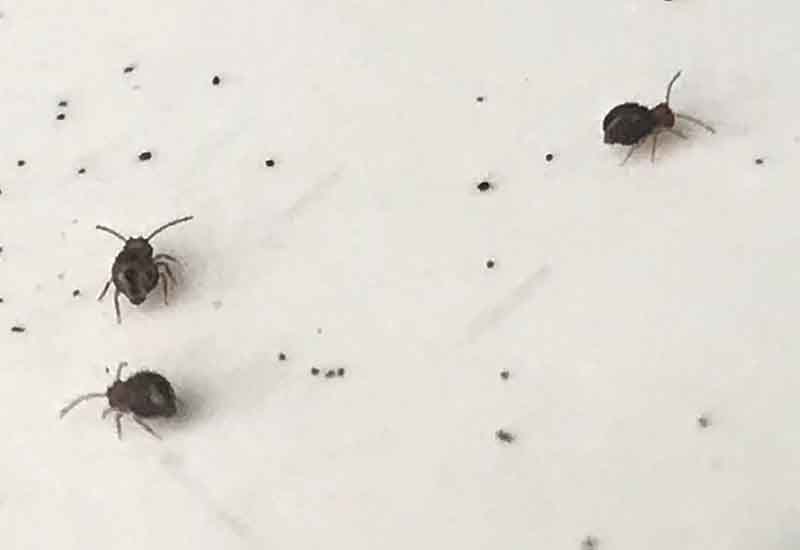
Do Springtails Fly?
This tiny bug that jumps does not fly, but it does run, walk and even climb. You might get confused between their flight and jump because their jumps are quite spectacular.
Despite being about 8/100th of an inch in size, they can jump a distance of over several inches. That’s like a normal grown man jumping a ten-story building! To an innocent bystander, it sure looks like they are flying.
However, they cannot fly; they don’t have any wings. They are just jumping so high that it looks like they are flying. Springtails can jump both high and far.
Do Springtails Have Wings?
Like many other members of the phylum Arthropoda, springtails do not possess the two sets of wings attached to their thorax, which is necessary for flying. All they have is this amazing ability to jump, and they make the most of it.
Do They Bite?
Springtails do not bite humans. In the odd scenario, when they do bite, they do not cause any irritation to your skin. They love to live in those damp and moist places of your home, under the kitchen sink and in the water pipes, so you probably won’t even see them often. A dehumidifier can help with this.
However, springtails reproduce quickly, so it is possible to get a big infestation if your house is in an area where the air is humid.
Springtails do not damage potted plants but are attracted to organic matter such as leaf litter and moldy wood. Removing these can help you get rid of springtails.
To get rid of springtails, you need to clean near the area of anything that absorbs water, such as litter, wet wood, etc. You need to check your plumbing for leaks so that you don’t give these critters a comfortable home.
You can also call in pest experts, who eliminate adult springtails by vacuuming the walls, especially the damp ones.
They then follow it up by cleaning and drying the walls and floors of your house. You can also spray chemicals to kill adult springtails and their eggs around the house, our non-toxic, pet & children safe alternative is this insecticide.

Frequently Asked Questions
Do springtails jump on humans?
If you have a damp house, springtails will inhabit the walls, carpets, and even beds of your house.
But they usually do not jump on humans or bite them. They are not known to infest human skin or damage any furniture in a house.
Do springtails move fast?
Yes, springtails can move fast. They can cover a distance that is almost 100 times their length in one jump. They can do so by using their furcula.
Will springtails ever go away?
Springtails are pests, and removing them from your house is a tedious job. It’s best to seek professional help who might help you fix the moisture level of your house and plumbing and treat the infected area with chemicals, like an essential oil, non-toxic spray.

How do you find a springtail nest?
Springtails do not make any nests for themselves. You can find them in clusters in any moist and damp area of your house or on leaf litter, moist wood and bark of a tree, and under the pots of plants.
Wrap Up
Springtails are nuisance pests that might invade your home but will not cause skin irritations or damage your furniture.
They use their furculum to jump large distances (compared to their size). Scientists have been debating the mechanism of the jump for quite a few years now.
But all of them agree that an elastic element exists at the base of the furcula.
Most studies also agree that the entire body assists the springtail in its unique jumping motion. Thank you for reading about these marvelous creatures, and we hope you learned a bit about how they jump!
Springtails are attracted to damp environments, making them prone to invading houses. To deter their entry into your home, employing this common device is highly effective.