
In this article, we cover everything you would like to know about the huntsman spider.
One of the largest spider species, Huntsman spiders are found all across the world – and often make their way into homes.
Certain species may only be native to specific areas. Their main habitat is tropical and sub-tropical areas of Asia, Australia, North Africa, and the Mediterranean.
They are a feared species in the insect kingdom, as, they actively pursue their prey and crush them using the two pincers in front, giving them their unique name.
But are they friendly to humans? How do they live and mate? We answer all your questions about huntsman spiders in this article.


What Are Huntsman Spiders?
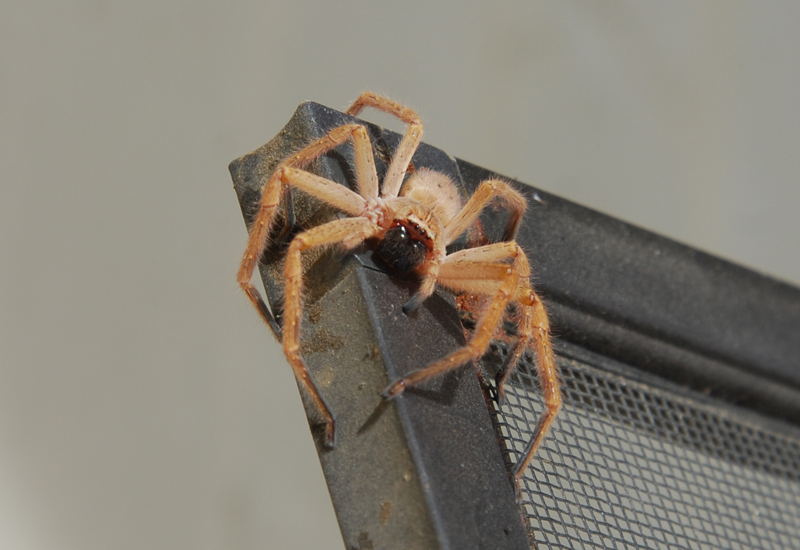
Brown in color with bands of grey on their legs, huntsman spiders are big, hairy spiders belonging to the Sparassidae family.
They have eight eyes and small bodies that are around an inch long. However, they have incredibly slender and long legs, reaching up to 5 inches (on average) when uncurled.
Due to their long legs and hairy body, people often mistake them for tarantulas. They are much larger in size than regular spiders.
In fact, the giant huntsman spider is the world’s largest spider if we measure them by leg span. They have two eyes on the front in two long rows, each containing four eyeballs.
Their mouthparts have a reddish patch. Different species may also have other colors all over the body. Badge huntsman can have an overall pinkish-brown body.
Some tropical species have alternating black and white bands on their legs.

How Big Is A Huntsman Spider?
Huntsman Spiders are among the largest spiders in the world. The giant huntsman spider is the world’s largest
Generally, females are slightly larger in size than males. Their bodies are up to 1 inch long. The span of the legs, when unfurled, can range from 3 to 5 inches.
For the giant huntsman, this can be as long as 12 inches.
How Fast Is A Huntsman Spider
Huntsman spiders can move very quickly. The fastest huntsman spider can run as fast as 40 times their body length in a second.
This means they can cover a distance of around 5 meters in a second. To compare to this, even the fastest humans can only reach a speed of around 5 times their body length.
Do They Jump?
Different species showcase different types of locomotion.
Mostly, huntsman spiders move via fast walking and using their web to spring from one region to another.
As long as they have some leverage, they can “jump” and cover distances.
Some, like the wheel spider and Moroccan flic-flac spider, move by using a cartwheel-type motion where they flip their body over and over.
Using this method, they can run nearly twice as fast.
Types of Huntsman Spiders
Huntsman spiders are a varied species. There are over 1,383 species classified under the family of Sparassidae. Let’s take a look at some of the types of huntsman spiders.
Carparachne
This name includes two different species, both of which are native to Namibia.
Similar to cartwheel spiders, the carparachne spiders also use a rolling motion to quickly traverse over sand dunes and escape its predators.
Cebrennus
This is the genus of the Moroccan flic-flac spider and has a total of 17 species within it.
Their interesting motion is now inspiring scientists to create robots that can replicate the movement and traverse quickly across sandy environments.
They are native to Morocco and parts of the Arabian peninsula.
Diminutella
This genus has only one species, Diminutella cortina. They are found only in Cuba.
Their discovery is quite recent – in 2018. Among all huntsman spider species, these are the smallest in size.
Heteropoda
This genus houses the largest of all huntsman spiders. The infamous giant crab spider belongs here.
Heteropoda survive in the tropical areas of North America, Australia, Asia, and the Mediterranean.
It is less hairy than other species and moves sideways, similar to a crab
Delena
This genus of huntsman spiders is home to 4 spider species.
Among them, the Delena Cancerides is a uniquely social species where many adults share the same nest without resorting to cannibalism.
Species of this genus – like the Delena gloriosa, Delena Nigrifrons, and the Delena lapidicola are all only found in Australia.
Apart from these, there are many other genera like the Leucorchestris, Micrommata, and more.
Where Do They Live?
They mainly live within the foliage or trees or within small crevices of tree barks.
On the ground, you may find them under fallen barks and rocks, burrowing in loose sand, or in any slightly dark and damp place.
What Do They Eat?
As their name suggests, huntsman spiders are aggressive and stealthy hunters.
Unlike some spiders who are passive hunters, simply waiting for prey to get caught in their net – huntsman spiders actively stalk their prey.
Their diet includes smaller insects and arthropods. They also feast on larger animals like slugs, lizards, frogs, and in rare cases – even mice.
Pests like mosquitos and cockroaches are a fan favorite!

Who Eats Them?
Some common predators are carnivorous birds and larger lizards or geckos. Spider wasps also hunt on the smaller spiders of the family.
Despite having eight eyes, the eyesight of this spider is only average, and they cannot see objects at a distance.
In fact, some species, like the eyeless huntsman spiders that survive in caves, do not have eyes at all!
Among parasites, they are susceptible to nematode worms and parasitic wasps that may lay eggs on their body.
As the larvae hatch within their body, the worms feast on the spider’s internal fluids, eventually killing it.
There are cases of scorpions eating them as well. However, this is not a regular occurrence.
Life Cycle of Huntsman Spiders
Huntsman spiders can live for as long as two years or sometimes more.
Huntsman spiders have quite a romantic courtship when compared to other spiders, where the female often eats the male.
After courtship, female spiders lay up to 200 eggs in a single egg sack, which has a paper-like cover.
She guards it without eating until the younglings hatch. This may take three weeks or more, depending on the climate.
In some species, the female can carry the egg sac around with her. Females guarding their eggs are aggressive and attack, sensing danger.

After the smaller spiders are born, the mother accompanies them for a couple of weeks more.
She may also tear the egg sac during its later stages to aid the small ones coming out. During the initial weeks, the spiderlings grow by shedding their skin in a process called molting.
Sometimes, males and females may remain together during this time. Some species, like the Flat Huntsman, live in large spider colonies where up to 300 adults rear their children.
How Long Do They Live?
The usual lifespan of a huntsman spider is around two years, though it can be more. Hatching of eggs takes around 2 to 4 weeks.
Their lifespan is overall quite short when compared to those of other solitary species like the tarantula. Tarantulas can live for 20 to 25 years!
Do They Bite?
Huntsman spiders have pincers and can bite. Moreover, their bites are venomous and cause a multitude of reactions in humans.
If you see one, it is best not to provoke it. They don’t generally bite humans and are defensive rather than offensive on seeing us.
However, females who guard their egg sacs can be quite aggressive.
How Venomous Is A Huntsman Spider?
For insects, very. They use their venom to kill insects and even larger slugs and lizards.
However, for humans, their venom is not fatal. Despite this, if you get injected with their venom, you might suffer from nausea, headaches, and some localized pain and swelling.
The venom can also alter and lower your pulse rate for some time.

Can They Come Inside Homes?
It is quite common to find some species of huntsman spiders inside homes – especially the Flat Huntsman.
As they live in warm climates, they are always in the search of cooler places. If you have smaller cracks or crevices in your home or along windows, these can make the spider feel right at home.
They are also attracted by food like cockroaches within their homes.
What Are They Attracted To?
Huntsman spiders are mainly attracted to food. As they go in search of the same, they look around for moths and other insects.
Since these insects are primarily found around light sources, you might catch a spider loitering nearby as well. They are foragers and constantly after food sources.
How To Get Rid of Them?
Having a spider in your home the size of a dinner plate is something to be worried about, for sure.
You can get rid of them quite easily without external help. But first, never use a broom to sweep away a large spider.
They are excellent climbers and quick movers who might start climbing on the broom itself.
Here’s what you can do to get rid of them:
- Place a large container on top of the spider. Slide a thin piece of paper from beneath it until the spider is on the paper. Now take the container outside and release the spider.
- To prevent them from coming in, you can use any type of citrus or peppermint spray. Spray these along your windows, doors, ventilators, and any open ledges. Spiders detest the spicy smell, and it will deter them from moving in.
- If you find many of them, it means there is an egg sac that has hatched somewhere. Find the source by looking through all cracks and crevices and call pest control for proper chemical treatment.
You can also deter them from coming in by making sure there are no food sources like moths and cockroaches in your home. Installing a mesh or net can go a long way.
Comparison With Tarantulas
Based on how similar they look, it is easy to confuse a huntsman spider for a tarantula or vice versa. But you can easily distinguish them by:
- Looking at their legs – Tarantules have legs that fold underneath their body. But huntsman spiders have legs that open outwards and sideways – similar to crabs.
- Looking at their body size – Tarantulas have larger, hairier bodies and shorter legs. Hunstman spiders have smaller and sometimes flatter bodies with long legs.
- Looking at their behavior – Huntsman spiders are more likely to scurry away if you approach them. Tarantulas, on the other hand, are more aggressive and likely to approach.

Comparison With The Wolf Spider
Both these species are venomous spiders found in similar habitats. Here are some distinguishing signs to look for:
- Looking at their color – Huntsman spiders have brown bodies with grey or brown bands on their legs. Wolf spiders can be pink, orange, salmon, cream, or grey, with larger black and white bands on their legs.
- Looking at their legs – Huntsman spiders are known for their long legs with multiple bends. Wolf spiders come nowhere close and have stubbier legs that curl inwards.
- Looking at their eyes – Wolf spiders have eight eyes set in a row. The huntsman spider has two rows of 4 eyes each.
Frequently Asked Questions
Do huntsman spiders hurt you?
Yes, the bite of a huntsman spider hurts and causes localized swelling. The venom can also cause headaches and nausea as it spreads.
They generally do not hurt humans but can if provoked. It is best to not touch them by hand.
What happens if you get bitten by a huntsman?
If you get a huntsman spider bite – seek medical attention immediately. Usually, your doctor will prescribe an anti-inflammatory medicine to prevent any fever or associated swelling.
If you are allergic to the venom, you will require further treatment. Swelling and pain will go down in a few days.
Which spider kills most humans?
According to the Guinness Book of World Records, the deadliest spider to date is the Funnel-web spider.
They are native to Australia. Though a bite may not necessarily contain venom – if they do inject venom, it is highly fatal with no known anti-venom.
Why do huntsman spiders run at you?
Huntsman spiders are not aggressive. If they run towards you, they are simply looking to escape you, by running into the shade.
However, sometimes, females protecting eggs may run at you to deter you from approaching the eggs.
Wrap Up
While not a common pet idea, people do keep huntsman spiders as pets in terrariums.
As long as they are left alone, huntsman spiders are non-threatening and quite chill.
A bite from them is not fatal and can be easily treated. Moreover, not all bites contain venom, as they mostly use venom to subdue prey.
But having said this, there are many impostors who look similar but are quite venomous. So it’s best to know how to identify various species.
Thank you for reading!


