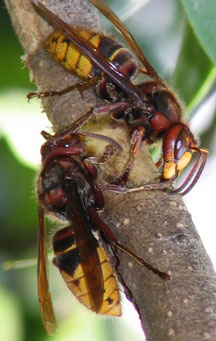
European hornets (Vespa crabro) are social wasps that can measure between 3/4 to 1 3/8 inches in length. These hornets, with their distinctive brown and yellow-striped abdomens, are native to Europe and Asia but have become established in the eastern United States since their introduction in the 1840s.
As colony builders, European hornets are often found constructing their fragile, paper nests in concealed locations, such as hollow trees and building structures. Understanding how far these hornets travel away from their nest is crucial, as this information can help people take appropriate precautions when encountering these wasps and managing any potential risks.
European Hornets: An Overview
Life Cycle and Habits
European hornets are social wasps known for their large size, ranging from 3/4 to 1 3/8 inches long1. These hornets hold various life stages, including egg, larva, pupa, and adult2.
- Queens: Fertilized females that establish new colonies and lay eggs
- Workers: Infertile females that defend the nest, care for the young, and forage for food
- Males: Reproduce with new queens
During fall, the fertilized queens overwinter in protected areas, while the rest of the colony dies off3. A new colony emerges every year.
Nest Characteristics
European hornets build fragile, tan paper nests in concealed locations4. Some examples of nest locations include:
- Hollow trees
- Barns, outbuildings
- Hollow walls of houses
- Attics
- Abandoned bee hives
Nests in the southern US can reach up to 2-3 feet in length5. However, in colder areas like Virginia, most nests are smaller. Here’s a comparison of nest sizes:
| Region | Nest Length | Diameter | Worker Population |
|---|---|---|---|
| Southern US | 2-3 feet (0.6-0.9 m) | 20 inches | 800-1000 |
| Virginia | Smaller sizes | Not specified | Fewer than 800-1000 |
Note that nests are annual and die out with winter temperatures6.
Nest Range and Travel Distance
Factors Affecting Travel Distance
European hornets typically build their nests in concealed locations like hollow trees, barns, outbuildings, hollow walls of houses, and attics1. The distance they travel away from their nests can be influenced by various factors such as:
- Food availability: Hornets may travel further when food is scarce to find prey like insects or other food sources2.
- Nest location: If their nest is located in a densely populated area with abundant food sources, they may not need to fly far to find food3.
Implications for Human and Wildlife Interactions
The travel distance and nesting habits of European hornets have implications for both humans and local wildlife. To name a few:
- Stinging incidents: While the hornets are not typically aggressive, they are more likely to sting if their nest is disturbed or threatened4.
- Impacts on local wildlife: European hornets feed on several insects, including pests like flies and caterpillars, providing a natural form of pest control. However, they may also prey on beneficial insects like bees5.
| Factor | Impact on Humans | Impact on Wildlife |
|---|---|---|
| Travel Distance | Risk of stinging | Pest control |
| Nest Location & Concealment | Stinging hazard | – |
To reduce the likelihood of European hornet encounters and negative impacts, it is essential to be aware of their nesting habits and avoid disturbing their nests6. If a nest is discovered near human activity, hiring a pest control professional to remove the nest is recommended7.
Preventing and Handling Infestations
Common Signs of Infestation
European hornets build fragile, tan paper nests in concealed places like hollow trees, barns, outbuildings, hollow walls of houses, attics, and abandoned bee hives1. Signs of infestation include:
- Observing hornets buzzing around or entering/exiting a small hole in your home or property
- Hearing a buzzing or humming sound coming from within walls or other hidden spaces
- Finding their distinctive tan paper nests
Safe Removal and Control Methods
If a nest is in a structure or near human activity, it’s best to hire a pest control professional with expertise in killing and removing European hornet nests2. However, some DIY methods can be attempted if the situation is not severe:
- Apply insecticide dust or spray in the entrance of the nest at night, when hornets are less active
- Seal up cracks and holes in your home to prevent future infestations
Pros and Cons of DIY Removal:
| Pros | Cons |
|---|---|
| Cost-saving | Potential risk of stings and allergic reactions |
| Immediate action | Less effective than professional removal |
| Temporary solution | May not get rid of the entire nest |
[sc name=”bugquiz” ][/sc]
Footnotes