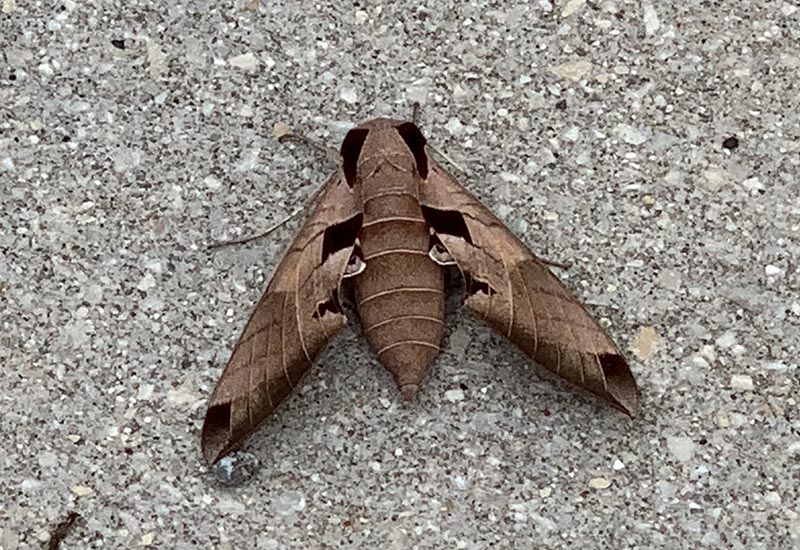
The Achemon Sphinx Moth (Eumorpha achemon) is a fascinating and fairly uncommon creature found in various habitats worldwide.
As a nocturnal moth, it can be quite a sight to behold during its active period, which typically occurs from late spring to midsummer.
These moths are known for their captivating appearance, sometimes showcasing a wingspan of 3 to 4 inches.
Besides, their wings have striking shades of light brown, pinkish, and gray. There are elegant dark colors on their forewings 1.

These moths feed on grapevines and Virginia creeper during their larval stage. As adults, the Achemon Sphinx Moth feeds on nectar from flowers, using its long proboscis to hover and slurp up this sweet treat 2.
In the natural world, these moths play a crucial role as pollinators while going about their nightly feeding routines.
Identification of the Achemon Sphinx Moth
Physical Features
The Achemon Sphinx Moth, also known as Eumorpha achemon, is a fascinating species. They possess:
- Furry legs: Adults have noticeably hairy legs which help in their movement.
- Wings: Their unique wing patterns contribute to their identification.
- Color: They exhibit a range of colors, primarily pink and brown hues.
Color and Markings
An adult Achemon Sphinx Moth displays varied coloration and markings:
- Light brown to dark brown: Their colors can range from light to dark brown shades.
- Pink hue: Some individuals may exhibit a pinkish hue across their wings.
Wingspan and Size
Achemon Sphinx Moths have sizeable wingspans and distinct features:
- Wingspan: Their wingspan ranges between 3.5 to 4 inches (9 to 10 cm).
- Forewings: The adults possess elongated and rectangular forewings.
- Hindwings: The hindwings are shorter and rounded.
- Dark brown patches: Both forewings and hindwings can display dark brown patches that help with camouflage.

Below is a table showing the physical features of the moth.
| Feature | Description |
|---|---|
| Physical | Furry legs, unique wings, and pink/brown coloration |
| Wingspan | 3.5 to 4 inches (9 to 10 cm) |
| Forewing shape | Elongated and rectangular |
| Hindwing shape | Shorter and rounded |
| Wing markings | Dark brown patches on both forewings and hindwings |
Lifecycle and Behavior
Egg Stage
The Achemon Sphinx Moth (Eumorpha achemon) begins its life as a tiny, round egg, usually laid on host leaves such as wild grape or woodbine. The eggs hatch after just a few days.
Caterpillars and Larvae
The larvae of the Achemon Sphinx Moth, also known as hornworms, go through several growth stages:
- First instar: Bright green, small, and highly active
- Later instars: Develops distinct color variations, ranging from green to orange to brown
Caterpillars mainly feed on leaves of grapevines and woodbine. Although they’re not considered a significant pest, they can cause minor damage to host plants.
Pupa Stage
When caterpillars reach full size, they pupate in the soil. Pupa is a resting stage where the transformation into an adult moth occurs.

Adult Moth and Mating
Adult Achemon Sphinx Moths have a large wingspan (3 to 4 inches) and are characterized by:
- A large, stout body, up to 2 inches long
- Primarily nocturnal and crepuscular behavior
- Active mostly during late spring and midsummer
During their short adult lifespan, they mate, lay eggs, and continue the lifecycle.
Feeding Habits and Flight Pattern
The Achemon Sphinx Moth feeds on nectar from various flowers, using its long proboscis.
They also feed on grapevine leaves, but they are not considered garden-destroyers since their populations don’t usually reach pest levels3. Some key aspects of their flight pattern include:
- Fast and agile flying, resembling hummingbirds
- Hovering while feeding, making them efficient pollinators
Habitat and Distribution
North America
The Achemon sphinx moth (Eumorpha achemon) is a member of the Sphingidae family, commonly known as sphinx or hawk moths.
They are found throughout North America, including the United States, Mexico, and Southern Canada, and are most active between June and August.
Mexico and United States
The distribution of Achemon sphinx moths spans across Mexico and the United States2.
In the US, they are prevalent in states like Florida and California, where grapevines are abundant.
Southern Canada
In Southern Canada, Achemon sphinx moths are part of the more than two dozen native sphinx moth species.
Though not as common as the white-lined sphinx moth (Hyles lineata), they can be found spanning the North American continent4.
Characteristics of Achemon Sphinx Moths:
- Family: Sphingidae
- Pollinators
- Most active between June and August
- Caterpillars feed on grapevine leaves
Comparison Table: Achemon Sphinx Moth vs. White-lined Sphinx Moth
| Features | Achemon Sphinx Moth | White-lined Sphinx Moth |
|---|---|---|
| Habitat | North America (United States, Mexico, Southern Canada) | North America (United States, Mexico, Southern Canada) |
| Activity Period | June to August | June to August |
| Food Source | Primarily grapevine leaves | Wide variety of plants, including willow weed and four o’clocks |
Host Plants and Impact on Agriculture
Virginia Creeper
Achemon sphinx moth larvae have been known to feed on Virginia creeper, a common plant that provides valuable nectar for various species.

These plants provide a substantial food source for achemon sphinx moth larvae.
However, this relationship doesn’t necessarily have a negative impact on Virginia creeper population, as the plants can tolerate some feeding by the larvae.
Vineyards and Grapes
Achemon sphinx moth larvae also feed on grapevines (genus Vitis) found in vineyards.
In viculture, controlling pests like the achemon sphinx moth is essential for grape production. A few notable impacts on grapes include:
- Larval feeding causes damage to grape leaves and vines
- Torn leaves can affect overall plant health and grape yields
Although this species may cause some detrimental effects on vineyards, they are not typically considered a severe agricultural pest.
Honeysuckle and Other Plants
Besides Virginia creepers and grapevines, achemon sphinx moth larvae are known to consume other plants such as honeysuckle and some orchid species in the Eumorpha genus.
A quick comparison table of host plants:
| Plant | Impact on Host | Importance in Achemon Sphinx Moth Diet |
|---|---|---|
| Virginia creeper | Moderate | Primary |
| Grapevines | Moderate | Significant |
| Honeysuckle | Low | Occasional |
| Orchids (Eumorpha) | Low | Occasional |
Conservation Status and Threats of Achemon Sphinx Moth
NatureServe Conservation Status
Regarding its conservation status, the Achemon sphinx moth is currently considered:
- Secure in terms of its population and range
- Not classified as an endangered or threatened species

Predators and Threats
Achemon sphinx moths face a few natural predators, and one of the well-known ones is birds. Here are some features of these moths, that make them potential prey:
- Their size and fat content make them an appealing meal for birds
- Markings and colors, along with their stripes, make them more visible to predators
However, the Achemon sphinx moth uses some defensive mechanisms to deter these predators, such as:
- Rapid and erratic flight patterns
- Feeding at night, reducing the likelihood of encountering bird predators
Conclusion
The Achemon Sphinx Moth (Eumorpha achemon) is a captivating and relatively rare species found in various habitats worldwide.
With its striking appearance and nocturnal habits, it provides a fascinating sight during its active period. These moths play a crucial role as pollinators, contributing to the natural ecosystem.
Although they may feed on grapevines and other plants, their impact on agriculture is generally considered moderate, and they are not classified as a severe agricultural pest.
It’s important to understand their conservation status and potential threats and ensure their preservation in the ecosystem.
Footnotes
-
(https://ipm.ucanr.edu/PMG/GARDEN/FRUIT/PESTS/spinxmoths.html) ↩ ↩2
-
(https://education.mdc.mo.gov/discover-nature/field-guide/sphinx-moths-hawk-moths) ↩ ↩2
-
Managing Pests in Gardens: Fruit: Invertebrates: sphinx moths—UC IPM ↩
-
Achemon sphinx moths’ range is shrinking | Colorado Arts and Sciences ↩