
Many people breed and actively attract lacewings to their gardens. But do lacewing larvae bite, and if so – is it dangerous in any way? Let’s find out.
Working among plants comes with its own set of challenges. While it’s all good to want to have bugs that eat up pests in your garden, once the pests are gone, those very “beneficial insects: can turn on!
Curious what unconventional products the bug enthusiasts here at What’s That Bug LOVE?
While we do enjoy and use the products recommended above, they are affiliate links where ‘What’s That Bug’ may receive a small commission at no additional cost to you. This helps to financial support this website from hosting to expert entomologists and writers who identify your bug requests and create the content you love.
Take the lacewing, for example; both the adult and the larva can bite you if you stand around them.
A lacewing larvae bite is quite common if you are a gardener working among plants that host them.

However, their bites are not dangerous and are simply a self-defense mechanism for these tiny insects.
They’re just more of an annoyance than an actual medical concern. Let’s learn more about how they bite and what triggers them to do so.
Do Lacewing Larvae Bite?
If you touch lacewing larvae on accident or disturb them, they can end up biting you.
However, this is not normal behavior for them, and they do so only for self-defense. You might even miss seeing them as they wear cast-away skins of other insects.
Their bite is not dangerous or toxic. But you might experience some itching along with pain and swelling of the area. If a larva clamps onto your skin, blow hard on it until it flies away.
How Do They Bite?
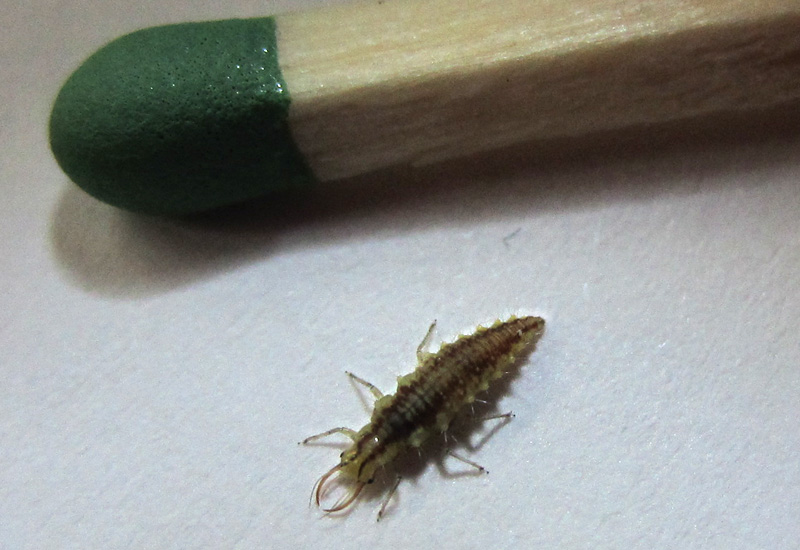
Lacewing larvae are predator insects, which means they survive off other, smaller, soft-bodied insects and insect eggs.
While they do not have a traditional mouth (like other insects) that has piercing and sucking parts – they can do the same actions using their jaws.
Lacewings have sharp, slender, and long jaws that they use to pierce things. The jaw hosts a series of hollow grooves with maxillae cover.
Maxillae are long, sucking tubes – also common in most insects. This channel produces saliva, which helps break down the prey and turns it into a more mushy and easily digestible format.

Lacewings can only eat liquid food, and their “bite” is simply a clamping of the jaw with no toxins.
On sensing danger – like sudden movement due to a gardener doing their job, they get agitated and clamp onto their skin.
Bites are usually by accident and are not common larval behavior. Larvae are also more prone to biting than adult lacewings.
Only one lacewing family of larvae, which is the Chrysopidae has strong enough jaws to pierce through human skin.
Do They Suck Blood?
A green lacewing larva can suck out the mushy insides of insects. However, they do not suck blood if they happen to clamp onto human skin.
Blood-sucking insects are called sanguinivorous, and lacewings do not fall under this category. Their primary food source is invertebrates.
Are Their Bites Dangerous?
On biting, aphid lions eject saliva through the maxillae. The saliva contains certain enzymes that help in pre-digesting insects. These enzymes are the reason a lacewing bite can turn itchy.
The area of the bite will also swell into a papule with some immediate pain.
However, the saliva is non-toxic, so the bite does not require medical attention. Any symptom will go away within a few hours or a day at most.
What To Do If You Get Bitten?
A lacewing bite does not need special medical attention. But you can stay safe by treating the bite with soap, water, and an anti-bacterial solution.
There haven’t been any cases of lacewings infecting humans with pathogens.
But having said that – some species of green lacewings do carry bacteria. Rickettsia is a common bacteria that some lacewings host, and the two exist in a symbiotic manner.
Rickettsia can affect both humans and plants. However, since lacewings do not suck blood, pathogen transmission is rare.
The chances of getting Rickettsia from parasitic insects like fleas, ticks, and mites are higher.
Do Adult Lacewings Bite?
Adult lacewings survive on nectar and pollen. They are not as predatory as their young ones and have a more plant-based diet (though some species look for insect prey).
Adult mouthparts are not suited for chewing.
Hence, bites from adult lacewings are very rare. You might still end up getting a bite if you happen to swat or disturb them!
Frequently Asked Questions
Are lacewing bites poisonous?
Lacewings do not inject any poison and are non-venomous on biting. They only eject saliva. Their bites, though initially painful, are not poisonous. They usually go away on their own after some time – similar to mosquito bites.
What does a lacewing bite look like?
A typical lacewing bite is a small, red bump that resembles a local papule. The person will also experience itching in the area. The bump is closed and does not ooze blood or bodily fluids.
Lacewing bites do not need any significant medical attention. They typically heal by themselves in a day or two. If you are allergic to insect bites, you should consult once with your doctor.
Can green lacewings bite humans?
Both brown and green lacewings and larvae can bite humans. But they only do this if disturbed or on sensing danger to themselves.
Though the bites are non-toxic, an insect infestation can result in multiple bites, which is an annoyance for gardeners.
What do lacewing flies look like?
There are two types of lacewing flies – green and brown. Both have large, golden orb-shaped eyes and nearly translucent wings.
The wings have veins in them, which gives them the appearance of tiny laces (hence the name).
Interestingly, the color in the names is not always the color of the insect – green lacewings also turn brown during the fall.

Wrap Up
Lacewings are beneficial insects to have to keep mites and aphid populations in check. If you want to introduce aphid colonies into your garden, get some lacewing eggs and breed them.
Unless there are so many that it makes working in the garden impossible – you have got yourself a natural insecticide! Thank you for reading.


