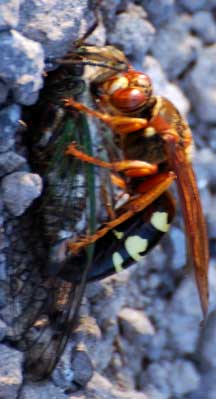
Cicada killers hunt for cicadas, but do they actually eat them? Let’s find out.
Cicada killers are one of the giants among the different species of wasps worldwide. Despite their formidable appearance and size, these wasps do not have highly aggressive behavior like yellow jackets.
But have you ever wondered what these giant wasps eat in order to become so big?
It is clear by the name that they hunt cicadas, but as adults, this is not what they eat. In fact, cicadas are what they eat at the start of their lives, when they are just freshly hatched larvae.
So let us take a look at what these wasps really consume.

What Are They?
Sphecius speciosus, also known as cicada killer wasps, is one of the largest species of wasps on earth. These giants can grow to become a whopping 2 inches in length.
They have a dark brown or black colored body with sets of yellow markings on their abdomen. Also, if you look closely, you will see that these insects have amber-colored wings.
Being true to their name, cicada killers are one of the major predators of cicadas. The females are experts in hunting the noisy cicadas to feed the wasp larvae. They are solitary wasps and prefer to build underground nests for laying eggs.
What Do Cicada Killers Eat?
Despite being active cicada hunters, adult cicada killer wasps feed on flower nectar and other plant juices. The cicadas are just for their young.
You must note that the cicada killers do not consume plants directly – they aren’t pests. They feed on nectar and plant fluids obtained from plants, and as such, they are also accidental pollinators in your gardens.

What Do Their Larvae Eat?
Unlike adult cicada killer wasps, wasp larvae highly depend on consuming cicadas to grow and fulfill their dietary needs.
The female cicada killers are known to hunt cicadas by turning them on the back and straddling them. They then carry it to the burrow, where they sting the prey to paralyze it.
The burrow contains multiple cells, and each of them is filled with at least one paralyzed cicada. She then seals off the burrow entrance leaving sufficient food for her young.
Interestingly, female cicada killers know which of the eggs will be females. She provisions extra cicadas for the females because they need more nutrition to bear eggs.
It takes around one or two days for the eggs to hatch; the paralyzed cicadas are the only food source for these larvae.
After receiving sufficient nutrition, they mature into a cocoon to survive the winter. Once the conditions are suitable for living on the surface, they emerge.

What Are Cicada Killers Attracted To?
As the name suggests, cicada killers are majorly known for hunting noisy cicadas. They are usually attracted to areas that have a good population of cicadas.
Moreover, these wasps are nectarivores, so they are attracted to flowering plants.
These wasps like to dig burrows in sandy areas, sparse lawns, edges of sidewalks, concrete slabs, and more.
A female cicada killer uses its strong legs to dig underground burrows in these areas to create a nest.
Frequently Asked Questions
What happens if a cicada killer bites you?
A cicada killer sting will not be as painful as the ones received by a yellow jacket or a red paper wasp.
If one of these wasps bites you, you will experience a little pain accompanied by some swelling and redness. However, if the sting triggers an allergic reaction, immediately visit the doctor.
How long does a cicada killer live?
The cicada killer wasp has a short life cycle. An average male cicada killer wasp lives for almost two weeks; they spend their life mostly patrolling and fighting. Once they mate, they die.
The female cicada killer wasp lives for about four weeks because she has to perform the important duties of digging burrows, hunting for prey, and laying eggs.
Do cicada killers eat plants?
No, they don’t. Despite their extreme fondness for hunting cicadas, like other wasps, adult cicada wasps depend on drinking nectar and other plant juices.
They are not pests like aphids or caterpillars who feed directly on plants.
However, the larvae are known to consume cicadas until they are fully mature as adults primarily.
Where do cicada killers go at night?
Cicada killers usually prefer to stay away from people during the night. Instead of coming out, they tend to remain in their well-constructed underground nests.
Therefore you are unlikely to come across any cicada killer wasp during the night hours.
Wrap Up
Cicada killers are fascinating creatures with a giant size and gentle behavior towards humans. These less aggressive wasps are often misunderstood to be active attackers.
We hope this article clears that misconception and you now know that they don’t eat anything that may harm you or your pet. Thank you for reading!