Snakeflies aren’t snakes or flies—they’re ancient predatory insects that have lived for over 50 million years. Found mostly in cooler climates, they feed on pests like aphids and mites, making them helpful for gardens and orchards.
Though their long necks and sharp jaws look intimidating, they don’t sting and rarely bite humans. If they do, the bite might hurt but isn’t dangerous. These shiny black insects are weak fliers, attracted to lights, and best left alone—they’re nature’s tiny pest control team.
Snakeflies are an old species that have been around and unchanged for a long time.
As per fossil records, they have been around for more than 50 million years!
Read on to get these and more interesting facts about snakeflies.

What Are Snakeflies?
Belonging to the order of Raphidioptera, snakeflies are a group of small, black, predatory insects that flourish across the world.
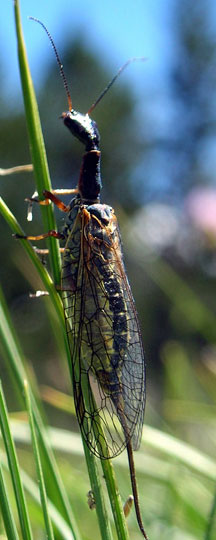
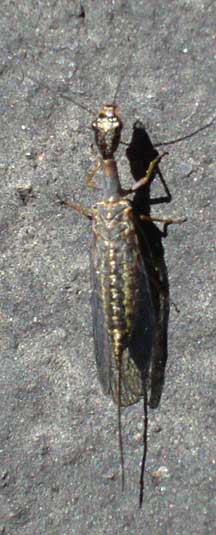
The body of the snakefly has three separate segments.
The second segment, called the prothorax, is long and ends in a flattened head. The elongated prothorax lends it a snake-like appearance and, consequently, the name.
They have thin, translucent wings with a network of visible veins, just like lacewings. Their bodies are shiny black in color, with 2 compound eyes. The larvae are reddish to gray in color.
Evolutionary History of Snakeflies
To date, scientists have identified around 200 species of snakeflies. In fact, as recently as 2009, H. Aspöck & U. Aspöck discovered two more new species of snakeflies.
As we said earlier, snakeflies have been around for much longer than humans, and as per the latest fossil studies, we believe they might have been here even 50 million years ago.

Despite this, the extant snakeflies we see today are quite similar to the ones found in the Jurassic period.
Moreover, fossil records also show that there was a time when these bugs used to live in the tropical regions of the world.
However, over time they have moved away and now live only in places where the climate is much colder.
Today, cold weather has become a major part of their lifecycle.
It is believed that the very change from cold to slightly less cool weather triggers their metamorphosis from larvae to adults.
Scientists are not sure when or why this happened and why snakeflies did not keep their ability to live in warmer climates.
Where Do They Live?
Snakeflies are found all over the world, mostly in colder climates.
Their distribution ranges from Europe to Asia, Africa, and parts of Central and North America.
Most of the population concentration is in East Asia. The only continents they do not inhabit are Antarctica and Australia.
They are commonly found in coniferous forests, living on trees, or in the soil. Larvae nest beneath tree barks or loose piles of leaves.

What Do They Eat?
Both adult snakeflies and larval instars are predators. They prey on smaller, soft-bodied insects, aphids, caterpillars, insect eggs, and mites. They are an important predator in the forest ecosystem and are beneficial in orchards.
Especially in pear orchards, they feed on the pear psylla – a pest that sucks out the sap from pear fruits and trees.
Studies show pollen in the digestive tracts of snakeflies. But whether they actually drink nectar or not is unclear. Their behavior is territorial and predatory.
What is the Lifecycle of Snakeflies
Females lay eggs that are long and cylindrical in shape. The larva that emerges is flattened, shiny, and has large, projecting mandibles.
The instar stage of the snakefly larvae is quite interesting. Unlike other insects that have a fixed number of instar stages (usually 3 or 4) – snakeflies can go through as many as required.
They remain in the larval stage for as long as three years and can go through 10 instar stages.

Larvae feed on smaller insects and finally go into a pupa. The pupa is active, which means it is capable of reacting by biting or walking upon sensing danger.
The mandible of the larvae also helps it to chew its way out from the pupae.
Depending on the temperature, the larvae mainly remain within the pupa for many months waiting for the ideal temperature.
When scientists subject the larvae to a constant temperature range, they sometimes end up in a stagnant state where they never undergo chrysalis.
But under ideal circumstances, as the temperatures rise, adult snakeflies emerge.
Female snakeflies are bigger than males and have an ovipositor at the end to deposit eggs within barks or the soil. An adult snakefly is smaller than an inch.
Do They Bite or Sting Humans?
The mouthparts of both adults are larvae that are non-specialized but are strong and capable of biting. The larvae also have projecting mandibles.
Having said this, they do not usually bite humans. They are beneficial for orchards and plantations as they help keep mites and aphids in check.
However, there do exist records of people being bitten by the larvae (read the emails section)!
If you see them indoors, just dispose of them with a vacuum. They cannot sting, though the females have an ovipositor which may look similar to a stinger.

What To Do If They Bite?
A snakefly biting a human is quite rare. But we do have records of both larvae and adults biting our readers, and the bites are said to be quite painful.
Adults, especially females, can be aggressive if they sense danger and resort to biting.
While the bite can be painful, you can simply pick off the insect and dispose of it. Treat the bite with a cold compress, followed by an antibacterial solution and ointment.
Are They Poisonous or Venomous?
Snakeflies are not poisonous or venomous to humans. Their bites are painful but do not cause any additional swelling.
No medical visit is necessary. The pain is similar to being pricked by a large ant. However, it goes away soon, even without any treatment.
Are They Harmful to Humans as Pests?
Snakeflies are not considered pests. Pests attack plants and crops, feeding on fruits, flowers, and plant sap.
They are predatory and do not harm crops in any way. On the contrary, they are a good addition to your garden since they eat up smaller pests.

Are They Beneficial?
Generally, they are beneficial for gardens, plantations, and orchards. They destroy the eggs, larvae, and pupa of many smaller insects like mites and aphids, which feed on plant sap.
A good garden ecosystem will have enough of these predatory insects to keep the crops in check.
Can They Come Inside Homes?
It’s quite possible for adult snakeflies to fly into homes. If you happen to see some, do not touch them with your bare hand. It’s best not to squash them.
Instead, use cardboard to swat them away and dispose of them outside. In gardens, you can spray insecticides on plants if you suffer from a snakefly infestation.
The insecticide will kill their food source and eventually starve the snakeflies.
What Are They Attracted To?
Snakefly adults are nocturnal. They are attracted to light. This could be one of the reasons why you end up finding some in your home.
Scientists also use pheromones that attract them to trap them in black boxes and use them for studies.

How To Get Rid of Them?
Ideally, you need not get rid of snakeflies. If they enter your home, the first step should always be to remove them from there and leave them in the garden.
To prevent them from entering your home, seal all crevices and use screens on your windows. Put a mesh around any other opening or ventilation space.
However, if there is an infestation in your garden, you can spray your plants with a narrow-spectrum insecticide.
The lack of smaller insects as food will cause the snakeflies to starve or move elsewhere.
You can also spray the insecticide on tree bark or the top soil layer where the adults lay their eggs.
But beware – that lack of predatory insects can cause plant-eating insects to rise in number once the insecticide wears off.

Interesting Facts About Snakeflies
- Snakeflies have been around since the Jurassic period.
- They are very clumsy fliers. Their flight patterns are unruly, and they often bump into things.
- Snakeflies lick themselves thoroughly before mating in an effort to groom themselves!
- Snakefly larvae can move both forward and backward using a process called undulation.
Frequently Asked Questions
What does a snakefly do?
Snakeflies mainly spend their lives feeding on other insects. Both adults and larvae are predatory and pretty good ones at that.
They are very territorial and aggressive, even during the pupal stage. The pupa can even bite if disturbed!
What do snake flies look like?
Larval snakeflies have a dark red to gray segmented body with a large mandible. Adults are black with an elongated thorax and a flattened head.
Their wings are transparent, riddled with veins, and form a roof-cover-like structure when they rest.
Can a snake fly in the sky?
All species of snakefly adults have papery thin wings that allow them to fly. However, they are weak flyers and mostly focused on hunting than flying in the sky.
Larvae look very different from adults. They are wingless and flightless.
Are drain flies harmful to humans?
Drain flies are commonly found grey flies that breed in moist areas like sinks and sewers. They cannot bite or sting and are non-toxic.
However, they carry pathogens from foraging around in the trash and can transfer those to humans. They can also cause allergic reactions.
Wrap Up
Snakeflies are found in abundance but are still interesting insects to study. They are one of the few insects that can form a pupa that is capable of biting and movement.
Their lifespans are long, and the larvae can keep growing until a suitable season for pupating. There are still ongoing studies to know more about them.
Thank you for reading.

 Snakefly
 snakefly