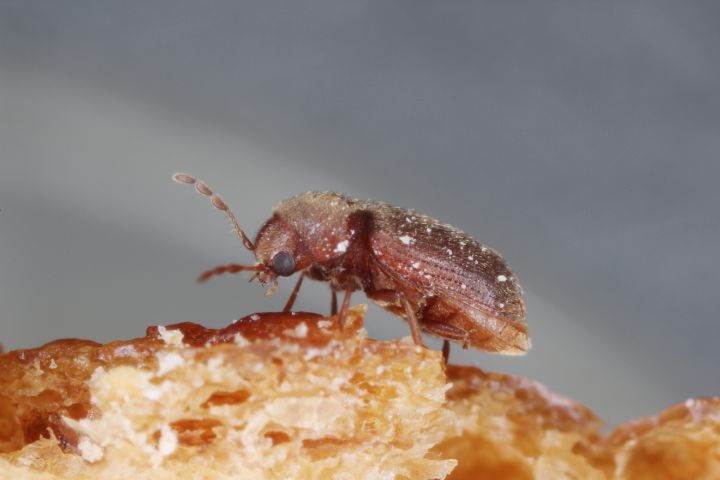
Brownish black insect in your bowl of food? You’ve got a pantry beetle problem! Don’t worry; here’s how to get rid of pantry beetles the easy way.
Imagine you are about to eat a bowl full of your favorite fried rice, and all of a sudden, you find a tiny beetle crawling around in it. Gross right?
Such situations can happen when your house is infested by pantry beetles. But what are these beetles? How can you identify them? And most importantly, how to get rid of them?
All of these questions will be answered in this article.

What Are Pantry Beetles?
Pantry beetles are a big family of beetles that infest food sources in homes and in commercial settings.
Most of them are reddish-brown to black in color, tiny in size, and can easily destroy entire batches of stored food items in a short period of time.
Pantry beetles are categorized into different types according to their feeding behavior. Here are a few of them:
Curious what unconventional products the bug enthusiasts here at What’s That Bug LOVE?
While we do enjoy and use the products recommended above, they are affiliate links where ‘What’s That Bug’ may receive a small commission at no additional cost to you. This helps to financial support this website from hosting to expert entomologists and writers who identify your bug requests and create the content you love.
Internal feeders
These are the beetles that spend their entire larval stage inside a carved cavity in grains that they infest. Weevils are a great example of internal feeders.
These insects can be easily recognized by their long snouts with functional mouthparts attached to its tip. The granary weevils and rice weevils are two of the common ones.
External feeders
As the name suggests, these beetles spend their entire life outside the damaged grains.
But unfortunately, these beetles are equally notorious when it comes to feeding and damaging food products.
Cigarette beetles, warehouse beetles, cabinet beetles, and drugstore beetles are a few of the prime examples of external feeders.

Secondary Feeders
These insects feed on the grains that have already been damaged by some other insects or are wet, moldy, and old.
The motive behind attacking damaged grains is to be able to consume fungus and mold growing on the grains. Mealworms and spider beetles are two great examples of this type.
‘What’s That Bug’ Product Recommendations:
Wondercide – Preventive Indoor Pest Control Spray Wondercide uses natural, plant-based essential oils to naturally repel pests. Cruelty-Free.
Dr. Killigans Non-Toxic Pest Control Specializes in non-toxic, natural products focused on removing ONLY the unwanted pests – not all insects.
BUG BITE THING Suction Tool – Natural Insect Bite Relief We love this simple product because it works without chemicals! Great for kids!
Large Bat Box for Natural Mosquito Control Too many mosquitos in your yard but don’t want to spray heavy chemicals? Try natures method!
Uncle Milton’s Giant Ant Farm The perfect gift so your kids can take an even closer look at the amazing underground world of ants. It’s the original.
Giant Butterfly Garden: Watch Caterpillars Change Into Butterflies! The perfect activity to do with your little ones to inspire them on how wonderful bugs can be.
Anti-Predator Chicken Coop with Runs Houses 4-6 chickens while offering outstanding protection and can be attached to other chicken coops.
While we do enjoy and use the products recommended above, they are affiliate links where ‘What’s That Bug’ may receive a small commission at no additional cost to you. This helps to financial support this website from hosting to expert entomologists and writers who identify your bug requests and create the content you love.
Scavengers
These pantry beetles do not damage whole grains; they only feast on the broken grains that are already damaged by the top two types.
These beetles also consume processed grain products. Red flour beetles and sawtoothed grain beetles are two examples of scavengers.
Difference Between Pantry Beetles and Pantry Moths
Pantry beetles and pantry moths are both troublesome creatures for stored food grains, but in order to keep them away from the grains, you must learn to differentiate between the two.
Pantry moths can fly, while most pantry beetles crawl. Also, if you notice closely, the moths usually fly in a zig-zag route.
While the adults in both species can be easily identified, it is tough to differentiate between the larvae.
The moth larva has several legs near the abdomen area, while the beetle larvae have either three pairs of legs or are legless.

Ways To Control Pantry Beetles
To control the pantry beetles, you must keep an eye on the food that comes into your house.
Pantry beetles, like rice weevils, attack grains in the field before the harvest. After harvesting, the infected rice travels to storage houses, and from there, it gets to your nearby store.
When you buy the infected rice, the weevil makes its way to your home.
Therefore as new food comes into your house, you should ideally store it in the freezer for a while. This will kill the already present pests in the food.
You must also store food grains in airtight containers to the attack of these beetles. Putting a few bay leaves in airtight grain containers can also help.
Ways To Prevent Them
Simply killing these weevils is not enough; you must take adequate measures to make sure that they do not return to your house.
If you find weevils in any of your grain containers and it is heavily infested, get rid of the entire batch.
Once that is done, clean the container thoroughly with soap water and do the same for the container rack before storing new grains.
Another way to get rid of them is by heating the grains at around 140 degrees F for about 15 minutes.
Doing so will kill the weevils and other beetles present in them. Also, since these insects can reside in the crevices of cupboards and drawers, keep cleaning them regularly as well.
[sc name=”bugquiz” ][/sc]
What To Do With Infested Food?
If you come across a few of these pantry bugs in your food grains, try to keep the batch open in sunlight for a while, this will help you to get rid of the beetles.
However, if the batch is heavily infested, get rid of the entire batch and clean the container and the surroundings, as mentioned in the above section.
Pantry Pest Traps (Pheromone Traps)
These are ideal for trapping different pantry pests like the Indian meal moth, confused flour beetle, and more.
Here the insects are attracted to the trap with the help of pheromones that attract them (using the same method the females use to attract the males).
The insects reach the pheromone source and get trapped by getting stuck on the sides of the trap. Once they are caught, you can easily get rid of them.
You should place these traps in the area where the infestation was previously noticed. Moreover, it is important to keep replacing the traps regularly so that you can catch as many bugs as possible.
Frequently Asked Questions
What causes pantry beetles?
Pantry beetles mostly enter homes via infested food sources that you purchase from the market. Therefore you must be extra careful with the food items that you bring home.
Don’t ever buy food items with signs of damage in the packaging. There is a high chance that they are infested.
How do I get rid of beetles permanently?
You can permanently get rid of beetles by using effective insect traps.
The pheromone trap is one effective tool that helps you to locate and eliminate pantry pests like Indianmeal moth, confused flour beetle, and more.
Once you have identified the area where these beetles live, use the rap to get rid of them. When that is done, clean the area thoroughly with soapy water.
How long does it take to get rid of pantry bugs?
You can get rid of pantry bugs in a short amount of time by either heating or freezing the infested grains for a while.
Doing so will kill the weevils present in the food source. If you are heating the food grain, make sure that you do so for around 15 minutes at around 140 degrees F temperature.
What are little beetles in my pantry?
The little beetles in your pantry are most probably pantry beetles. They are a big menace to stored grain foods and are highly capable of destroying them.
You need to take adequate measures to keep these insects away from your food grains. Storing the food grains in airtight containers is a good start.
Wrap Up
The existence of pantry beetles in your stored food grains or even dry pet food is bad news. These bugs are capable of destroying good batches of grains like rice and more.
Since they mostly enter homes through the food that they buy from the market, you should be extremely careful about what you bring to your house.
If they have already entered your home, use the suggestions given in the article to get rid of them. Thank you for reading the article.


