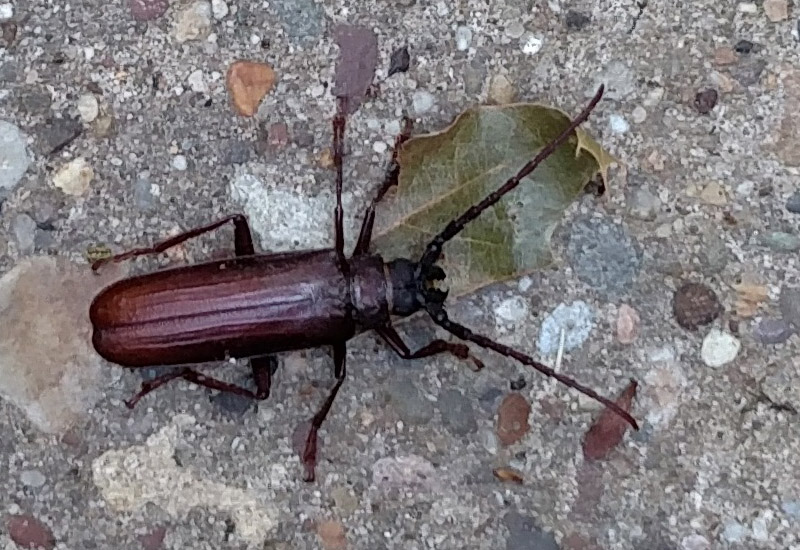
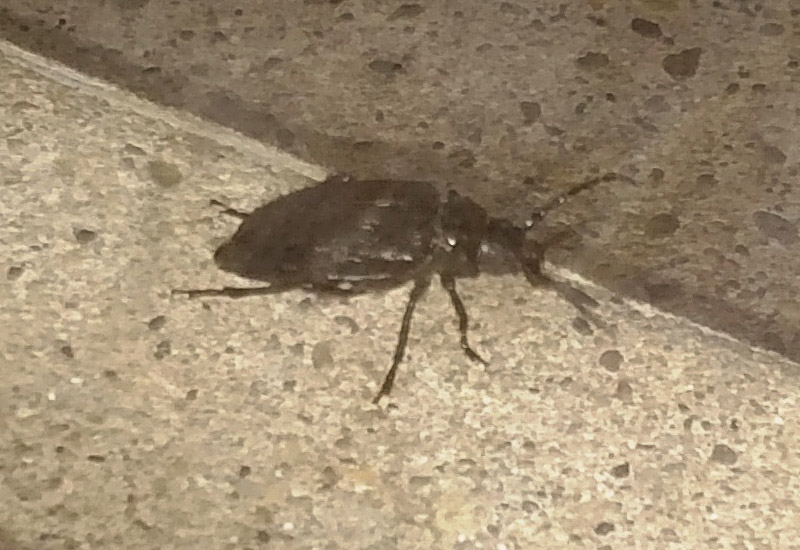
The broad necked root borers can be horrible tree pests. In this article, I will share some tips on how to get rid of broad necked root borer and keep their infestation at bay.
The broad-necked root borer (Prionus Laticollis) is a tree pest most common to deciduous trees.
These reddish brown or black colored insects are often mistaken to be the Asian longhorn beetle, but there are significant differences between them.
Broad Necked root borer, true to its name, causes damage to the roots of trees and can destroy the root system.
One of the few ways to get rid of these pests is through contact insecticides that contain pyrethroids.
I will talk about these in detail in the article below.

Are Broad-Necked Root Borers Dangerous?
The male broad-necked root borers have sharp mandibles, while the female ones are bigger, but their mandibles are not.
While these pests appear as though they could sting badly, they usually do not engage with humans. Neither do they bite or sting, nor are they poisonous.
The males use their mandibles only when fighting for territory with fellow males.
Female broad necked root borers have a very visible ovipositor at the end of the abdomen.
The ovipositor resembles a stinger and may look deadly, but in reality, it is the egg-laying structure in female insects that are not used for biting or stinging.
During the breeding season, the female will use the ovipositor to lay her eggs in the ground.
Hence even though root borers look like they could harm you, these notorious little pests are not dangerous to humans or animals.
But the same cannot be said for plants; they are gravely dangerous to their roots. Both young and very old trees are at risk from their infestation.

What Damage Do Broad Necked Root Borers Cause?
As their name suggests, broad-necked root borers are tree pests that affect and damage the roots of trees.
They usually attack weakened shrubs and plants. Hence it’s important to maintain your plant’s health using good fertilizers and regular trimming.
If your plant is young, a root borer infestation could kill it.
When it comes to older trees, an infestation at the roots could cause them to fall or get blown over.
Unfortunately, there aren’t any major indicators for a root borer infestation.
One telltale sign is the yellowing and thinning of foliage. You might also notice small holes or cracks in the bark and trunk of the tree or plant.
If you suspect a root borer infestation in a tree, the only way to confirm is by uprooting the tree itself.
If there is a severe infestation, the tree might be held to the ground by one or two roots only, so uprooting it would be very easy.

Differences Between Broad Necked Root Borers and ALBs?
The broad-necked root borers are often mistaken for Asian longhorn beetles (ALB). However, there are significant differences between the two.
Let’s start with the physical differences.
The Asian longhorn beetle has a narrow body with white spots, while the broad-necked root borer is more full-bodied and has no spots.
The root borer has much shorter antennae than the ALB and a visible ovipositor in females.
As far as their life cycle is concerned, the broad-necked root borers pupate within the soil and move towards and feed on trees once they transition into adults.
However, the female beetle lays eggs and lets it larvae pupate in a tree’s heartwood directly.
Both these insects are tree pests, but the ALB attacks the canopy of a tree while the root borers damage the root system of trees.
Lastly, unlike the ALB, the root borer also attacks fruit trees and shrubs.
In addition to deciduous, maple, and willow trees, root borers can also infest hickory, dogwood, pecan, and oak trees.

How To Get Rid of Broad Necked Root Borer?
It’s far easier and better to prevent a broad-necked root borer infestation than treat it.
But regardless, there are some ways you can treat it. Insecticides are the best way to get rid of broad-necked root borers.
Start with spraying a contact insecticide with pyrethroids on the outer surfaces of the tree, such as on the trunk, branches, and bark, to destroy live insect activity.
Pyrethroid insecticides with Cypermethrin are considered the best. Cypermethrin is an active ingredient that is useful in preventing a root borer infestation.
The earlier you treat the infestation, the better because this contact insecticide will prevent the newly hatched tree borer larvae from proceeding toward the trunk.
If you see borer holes in the trunk or loosened parts on the bark, inject aerosol insecticides directly into it.
This method will take care of insect activity behind the bark and attack beetle larvae and adult beetles.
If the infestation is more robust, dig holes around your tree in the soil and pour an insecticide mixture into it for the roots to absorb it.

Once the root system absorbs the insecticide, it’ll get dispersed upwards, preventing root borers from digging further.
It’s also a good idea to add some liquid fertilizer along with your insecticide mixture when applying it to roots.
The fertilizer will give your trees an additional strength boost and help keep them healthy further, just in case the root borer infestation is not very severe.
Natural Ways of Removing Broad Necked Root Borers
There are very few options when it comes to the natural control of these bugs.
Some insects, including Jepson’s beetle or Plaesius javanus, have been known to predate them in the food chain.
Ants and some birds can also eat them. However, the problem is that since they reside in the roots, they are very hard to see.
Preventing Broad-Necked Root Borers
As I said earlier, preventing an infestation is better than treating it. Here are a few ways to protect your trees from root borer infestation.
- Pruning and trimming your plants and trees is the top way to keep a root borer infestation away.
- Regularly cutting decaying leaves and branches will make your plants and trees uninviting to the root borers.
- Don’t forget to apply and seal the cuts and wounds from pruning with a prune paste.
- This will facilitate the healing process of the trees while also preventing the root borers from penetrating the trunk.
- One part of keeping your trees healthy also involves keeping the surroundings clean.
- Regularly clear out grass and fallen leaves from the base of the trees. Also, avoid littering near the trees.
- Less litter would mean fewer places for these tiny pests to hide. It will also make them easily visible to you or any other predator.
- Surround your trees and plants with mulch, organic fertilizers, and supplemental water to prevent the root borers from causing further damage.
- If you find significant damage to your tree/plant from the infestation, uproot it and replace it with a new one.
- Ensure you carry out the contact insecticides treatment for the new plantation to prevent a re-infestation.
Frequently Asked Questions
How do you control root borers?
By taking preventive measures and using treatments, root borers can be managed efficiently.
For prevention, you should plant seedlings of the proper size and strength and manage soil fertility properly.
Narrow-spectrum Insecticides specifically designed for root borers can help remove them from your garden.
Techniques such as mulching around plants also help to stop the pests from approaching plant roots.
Plants such as buckwheat or other flowering species can help attract adult root borers and keep them away from your crop trees.
How do you get rid of tree borers naturally?
Tree borers are a menace to your outdoor trees, but you can take action to prevent infestations and get rid of existing ones naturally.
Pruning and regularly inspecting trees for small holes and sawdust-like frass is one way to spot early signs of an infestation.
You can also use organic solutions such as natural oils and insecticide soap sprays to kill the larvae located inside the tree.
Additionally, applying sticky barrier wraps around the trunk can catch adults before they have a chance to lay eggs.
Taking these steps, along with providing proper nutrition, watering, and tending, will help ensure that your outdoor trees remain healthy and free from tree borers naturally.
What is the best remedy against borers?
The best remedy against borers is to use an Integrated Pest Management (IPM) program.
IPM is based on preventative measures such as good cultural practices, mechanical controls, and biological control.
This includes using resistant varieties, removing weeds, keeping plantings healthy, and using compost and mulch.
Biological controls can be helpful in managing borers by releasing beneficial insects that attack insect pests that may harm plants.
Mechanical traps or barriers can also be used to trap or exclude borers from the garden.
If needed, carefully chosen chemical treatments should always be a last resort and applied only where necessary according to label directions.
Is Neem oil good for borers?
Neem oil is effective in controlling borers because borer larvae are highly susceptible to the compounds found in Neem oil.
When applied to foliage, neem oil acts as a barrier so that borers cannot feed on the leaves and instead ingest the oil.
It also inhibits the growth of eggs and larvae by preventing them from processing food properly, as well as by interfering with calcium metabolism.
This makes it an ideal treatment for killing borers and deterring their return.
Additionally, neem oil is biodegradable and does not persist in the environment for long periods of time after application.
Wrap Up
The broad-necked root borers are tree pests that can damage a variety of trees by attacking their root systems.
The best way to deal with an infestation of these little buddies is to ideally prevent it.
You can do this by using contact insecticides and regularly maintaining your trees/ plants through pruning and using healthy organic fertilizers.
Thank you for reading!