
The Brush Footed Butterfly a family of butterflies (Nymphalidae) with around 5,000 species found across the globe.
It is the largest butterfly family and includes many well-known subfamilies.
One of the primary features of these butterflies is their reduced forelegs, hence the name “Brush Footed.”
These butterflies exhibit a wide range of colors and patterns, making them visually appealing and popular among butterfly enthusiasts.

Some notable examples of Brush Footed Butterflies include the Monarch and the Painted Lady.
They play a crucial role in pollination and serve as indicators of a healthy ecosystem.
In addition to their ecological importance, the Brush Footed Butterfly can also be a source of inspiration for artists, designers, and nature lovers alike.
Their varying wing patterns, sizes, and flight styles offer a captivating display of natural beauty that everyone can appreciate.
Brush Footed Butterfly Overview
Largest Family of Butterflies
Nymphalidae, also known as brush-footed butterflies, is the largest family of butterflies. They have:
- Over 5,000 species worldwide
- Various colors and patterns
Examples of brush-footed butterflies include Monarchs, Painted Ladies, and Mourning Cloaks.
They fall under the order Lepidoptera and superfamily Papilionoidea, which separates them from moths.
Classification and Phylogeny
Subfamilies and Clades
Libytheinae
The Libytheinae subfamily includes snout butterflies, which have elongated mouthparts resembling a snout.
Danaine Clade
The Danaine Clade includes the Monarch butterfly and other milkweed butterflies.
Ithomiinae
The Ithomiinae subfamily consists of clearwing butterflies, which usually have transparent wings and a preference for tropical habitats.

Clearwing Butterfly
Tellervini
The Tellervini is a tribe within Ithomiinae containing about 16 genera of mainly Neotropical butterflies.
Satyrine Clade
The Satyrine Clade includes several subfamilies, such as:
- Calinaginae: Often referred to as Oriental Wood-nymphs
- Charaxinae: Leafwing butterflies, known for their leaf-like wing shape and camouflage
- Morphinae: Morphos and Owl butterflies which showcase iridescent colors and eye-like patterns on their wings
Brassolini
The Brassolini is a tribe within the Morphinae subfamily, containing a diverse group of Neotropical butterflies.
Satyrinae
The Satyrinae subfamily features the “browns” and “ringlets,” which typically exhibit earthy tones and simple wing patterns.
A comparison table of selected subfamilies:
| Subfamily | Notable Features | Example Species |
|---|---|---|
| Ithomiinae | Transparent Wings | Clearwing |
| Charaxinae | Leaf-like wing shape | Leafwing |
| Morphinae | Iridescent Colors | Morpho, Owl |
Identifying Brush Footed Butterflies
Physical Characteristics
Some common characteristics of Brush footed butterflies include:
- Reduced front legs: These legs don’t have feet, but have little brushes of hairs used for sensing
- Color patterns: Many species are brightly colored, while others are camouflaged
- Wing patterns: Most have brown camouflage patterns on the underside of the wings
Various species within this family exhibit distinct physical characteristics, which we will discuss in the following subsection.
Notable Species
Here are some notable species of brush footed butterflies, along with examples of their unique features:
- Common Buckeye: Known for its striking eye-like patterns on its wings
- Monarch butterflies: Recognizable by their orange and black color pattern, these butterflies are well known for their incredible migration
- Admirals: These butterflies are identified by the bands of color on their wings

Weidemeyer’s Admiral
- Fritillaries: A diverse group including the Aphrodite Fritillary, Great Spangled Fritillary, and Meadow Fritillary
- Skippers: These small butterflies have a distinct moth-like appearance
- Milkweed butterflies: This group includes several species, such as the Baltimore and Eastern Comma, that rely on milkweed plants as their host
- Swallowtails: With over 600 species globally, these butterflies are characterized by prominent “tails” on their wings
- Tortoiseshells: Known for their unique, tortoiseshell-like patterns on the wings
| Species | Unique Features |
|---|---|
| Common Buckeye | Eye-like wing patterns |
| Monarch | Orange and black color pattern |
| Admirals | Bands of color on wings |
| Fritillaries | Diverse group, various patterns |
| Skippers | Moth-like appearance |
| Milkweed | Rely on milkweed plants as their host |
| Swallowtails | Prominent “tails” on wings |
| Tortoiseshells | Tortoiseshell-like patterns on wings |
With this information, you should be better equipped to identify various brush footed butterfly species in the wild!
Lifecycle of Brush Footed Butterflies
The lifecycle of the Brush Footed Butterflies, like all butterflies, is a captivating journey of transformation, encompassing four distinct stages: egg, caterpillar (larva), chrysalis (pupa), and adult butterfly.
Each stage offers a unique glimpse into the remarkable adaptability and survival strategies of these insects.
Egg
The lifecycle begins when a female butterfly lays her eggs on a host plant. The choice of plant is crucial, as it will provide the necessary nutrients for the emerging caterpillar.
The eggs are tiny, often spherical or oval, and may be laid singly or in clusters, depending on the species.
Caterpillar (Larva)
After a period, which can range from a few days to several weeks, the egg hatches to reveal the caterpillar. This stage is primarily a growth phase.
The caterpillar’s primary objective is to eat and grow, molting several times as its body expands.

Common Map Butterfly Caterpillar
Brush Footed Butterfly caterpillars are known for their reduced front pair of legs and their agile walking capabilities.
They exhibit a variety of colors and patterns, often serving as camouflage against predators.
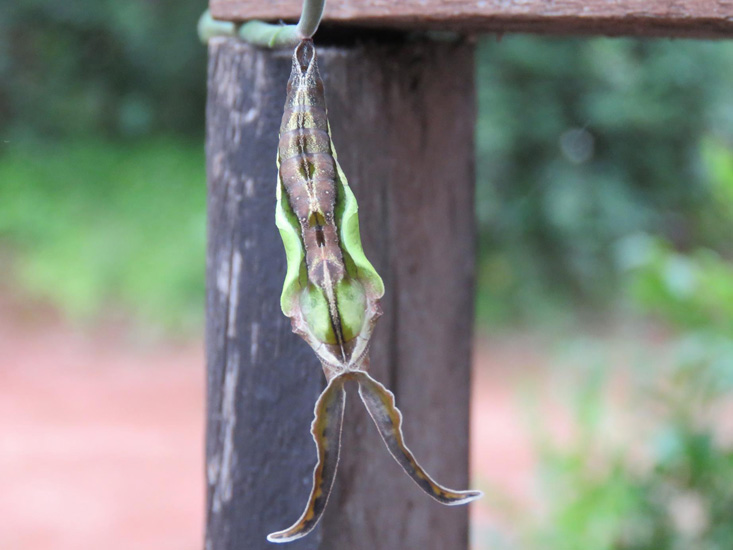
Chrysalis (Pupa)
Once the caterpillar reaches its full size, it seeks a sheltered spot to undergo its next transformation.
It anchors itself and forms a protective casing known as a chrysalis or pupa.
Inside this casing, one of nature’s most astounding processes takes place: the caterpillar undergoes metamorphosis, reorganizing its cells and body structure to emerge as a butterfly.
This stage can last from a few days to several months, depending on the species and environmental conditions.

Chrysalis
Adult Butterfly
When the transformation is complete, the chrysalis becomes transparent, revealing the butterfly within. The adult butterfly then breaks free, and after allowing its wings to dry and harden, it takes its maiden flight.
Adult Brush Footed Butterflies display a diverse range of colors and patterns, with some species showcasing striking iridescence or intricate designs. The adults then seek out mates to reproduce, and the cycle begins anew.
Summary of Lifecycle Stages
| Feature | Caterpillar | Chrysalis |
|---|---|---|
| Stage of Life | Larval stage | Pupal stage |
| Function | Eating, growing | Transformation |
| Leg Adaptations | Reduced front pair | Not present |
| Mobility | Agile walking | Immobile |
| Time Spent in Stage | Weeks | Days to Weeks |
| Predators | Birds, insects, etc. | Birds, insects, etc. |
Mimicry and Adaptations
Brush Footed Butterflies have evolved several remarkable mimicry and adaptation techniques. These include:
- Mimicking unpalatable or toxic species to deter predators
- Camouflaging as leaves, twigs, or other common objects
An example of mimicry can be seen in the Viceroy butterfly, which closely resembles the toxic Monarch butterfly.
This resemblance helps deter predators, increasing the Viceroy’s chances of survival.
Regional Distribution
North America
In North America, two prominent sub-families of brush-footed butterflies are the Libytheidae, also known as snout butterflies, and the Danaidae.
Let’s compare these sub-families:
| Snout Butterflies (Libytheidae) | Danaidae | |
|---|---|---|
| Habitat | Diverse habitats, forests to gardens | Mainly tropical regions, some temperate areas |
| Example Species | American Snout | Monarch Butterfly |
| Unique Features | Prominent “snout” feeding tube | Migratory, some species poisonous to predators |
Snout Butterflies
Snout butterflies (family Libytheidae) can be found in various habitats in North America, from forests to gardens.
The American Snout is one example of a snout butterfly species.

Snout Butterfly
Danaidae
The Danaidae family is more common in tropical regions, but some species can also be found in temperate zones within North America.
One renowned example is the Monarch Butterfly, which has a fascinating migratory pattern.
Other Regions
Besides North America, brush-footed butterflies are also present in other regions with diverse species and characteristics.
- South America: Rich variety of species, predominantly found in the tropical rainforests
- Europe: Species like the Peacock, Comma, and Red Admiral can be found, preferring woodland and garden habitats
- Asia: Many species present, including the markedly large Atlas Moth found in tropical forests
- Africa: Includes the spectacular African Giant Swallowtail butterfly, known for its size and striking patterns
- Australia: Unique species such as the Australian Painted Lady and the Orchard Swallowtail reside in different habitats across the continent
Appreciating Brush Footed Butterflies
Butterfly Identification and Gardening
Brush footed butterflies are part of the Nymphalidae family and have a diverse range of species with varying colors and patterns.
Some common butterfly types within this family are Sulphurs, Coppers, Blues, and Hairstreaks. Identifying these butterflies relies on features such as:
- Color patterns
- Wing size
- Presence of wing “tails” or hair-like extensions
Creating a butterfly garden can help attract and support these beautiful creatures.

Sulphur
Plant a variety of nectar-rich flowers and host plants specific to the different types of brush-footed butterflies. For example:
- For Sulphurs: Plant legumes and clover
- For Coppers: Provide milkweed and sorrel
- For Blues: Include vetch and alfalfa
- For Hairstreaks: Plant oak and willow trees
Literature and Science
Brush-footed butterflies have been well-documented in both scientific literature and other forms of literature.
For example, Jonathan P. Pelham’s Catalogue of the Butterflies of the United States and Canada provides a comprehensive list of butterfly species, including those in the Nymphalidae family.
In science, researchers often study these butterflies’ unique characteristics, such as their reduced front legs with brushes instead of feet. These brushes aid in smelling and tasting their surroundings.
Conclusion
In conclusion, the Brush Footed Butterfly, belonging to the Nymphalidae family, showcases the incredible diversity and beauty of the natural world.
With around 5,000 species globally, these butterflies captivate with their myriad colors, patterns, and unique features.
Their ecological significance, from pollination to serving as ecosystem indicators, underscores their importance.
By understanding their characteristics, habitats, and behaviors, we can better appreciate these winged wonders and contribute to their conservation.
Footnotes

 |
 |
| Hickory Tussock Moth Caterpillar | Banded Tussock Moth Caterpillar |
 |
 |
| Buck Moth Caterpillar | Io Moth Caterpillar |
 |
 |
| Monarch Caterpillar | Banded Woollybear Caterpillar |






.