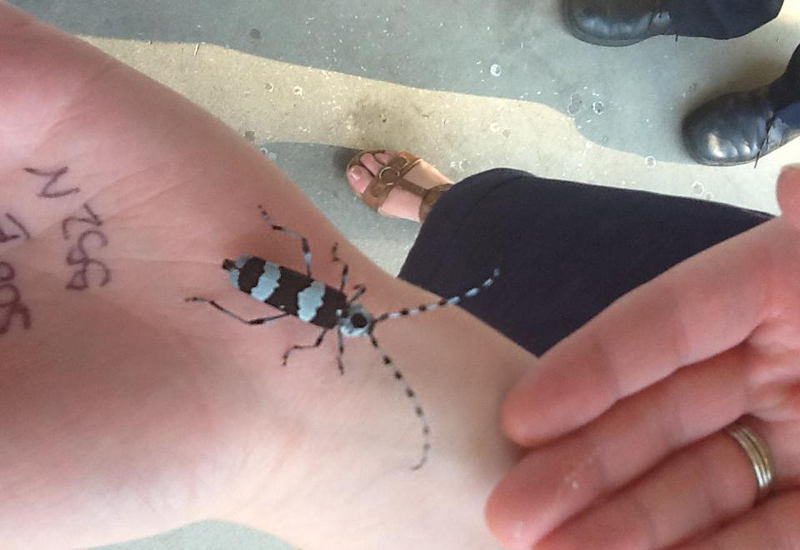
The banded alder borer (Rosalia funebris) is a visually striking beetle native to the Pacific Northwest.
Often encountered between March and August, this insect is characterized by its bold white-blue and black coloration, making it stand out among other beetles.
They primarily infest alder, ash, and California laurel trees, with occasional appearances on other hardwoods as well1.
In order to manage and control the banded alder borer population, it is essential to have some knowledge about this species.
Here’s what you need to know to understand these fascinating creatures further.

As mentioned earlier, their unique appearance makes them easily identifiable. In addition, they play a role in breaking down dead and dying trees, making way for new forest growth1.
However, the banded alder borer can also cause some problems. If it infests healthy trees, it can cause structural damage and make them more susceptible to other pests and diseases.
It is crucial to strike a balance between understanding their ecological role and responsibly managing their populations to maintain healthy forest ecosystems1.
Banded Alder Borer Identification
Physical Features
The Banded Alder Borer (Rosalia funebris) is a distinctive beetle known for its striking appearance. Some key physical features of this species include:
- Coloration: They have a unique white-blue and black pattern on their elytra (wing covers).1
- Antennae: These beetles possess long, black antennae, which can be as long as their body.
- Size: They are generally around 1 inch (2.5 cm) in length.

Similar Species
Although the Banded Alder Borer has a distinct appearance, it can sometimes be confused with the California Laurel Borer (Rosalia funebris).
Both species share a black and white pattern, but there are noticeable differences:
| Feature | Banded Alder Borer | California Laurel Borer |
|---|---|---|
| Color | White-blue and black | Black and gray |
| Antennae | Long and black | Shorter and gray |
| Pattern | Bold bands | Less defined pattern |
| Habitat | Alder, ash, and occasionally other hardwoods1 | Primarily California laurel^[2] |
By comparing these characteristics, it is easier to distinguish between the Banded Alder Borer and the California Laurel Borer.
Distribution and Habitat
Geographical Range
The Banded Alder Borer (BAB) is predominantly found in North America, specifically in the Pacific Northwest region, including parts of the U.S., Canada, and Alaska1.
In the United States, its range extends from Alaska to California, and eastward to Montana and New Mexico2.
Host Trees
BAB mainly infests hardwood trees, such as:
- Alder
- Ash
- California Laurel
- Willow
- Oak
Occasionally, it targets other hardwood species as well3. In Asia, these beetles have been reported to infest ash trees4.

The following table summarizes the BAB’s preferred host trees and their common regions:
| Host Tree | Common Regions |
|---|---|
| Alder | North America, Alaska |
| Ash | North America, Asia |
| California Laurel | California |
| Willow | North America, Mexico |
| Oak | North America, Canada |
Life Cycle and Behavior
The Banded Alder Borer (Rosalia funebris) is a beetle from the family Cerambycidae. This species has a distinct life cycle that goes through three stages – eggs, larvae, and adults.
Eggs
- The female Banded Alder Borer deposits eggs in cracks or crevices of hardwood trees.
Larvae
- After hatching, the larvae burrow into the wood, feeding on its tissue.
- This stage can last for up to two years.
Adults
- They emerge from the trees, displaying distinctive black and blue-white patterns.
- Adults are active from March to August.

Key characteristics:
- Family: Cerambycidae
- Host trees: Alder, Ash, California Laurel, and occasionally other hardwoods
- Life cycle: Three stages (eggs, larvae, adults)
- Migratory patterns: Predominantly Pacific Northwest
Here’s a comparison of Banded Alder Borer (BAB) with a common pest, the Emerald Ash Borer (EAB):
| Feature | Banded Alder Borer | Emerald Ash Borer |
|---|---|---|
| Family | Cerambycidae | Buprestidae |
| Host trees | Alder, Ash, Laurel | Ash trees |
| Region | Pacific Northwest | North America |
| Major damage | Aesthetic damage | Tree death |
| (info from BAB and EAB) |
To summarize, Banded Alder Borers go through three life stages and are primarily found in the Pacific Northwest region, where they feed on hardwood trees such as Alder and Ash.
While their presence can cause aesthetic damage to trees, they are not as destructive as the invasive Emerald Ash Borers.
Classification and Evolution
Taxonomy
The Banded Alder Borer (Rosalia funebris) is a species of beetle belonging to the order Coleoptera, which is the largest order of insects.
It falls under the class Insecta and the phylum Arthropoda. Here is the detailed classification of the Banded Alder Borer:
- Phylum: Arthropoda
- Subphylum: Hexapoda
- Class: Insecta
- Order: Coleoptera
- Suborder: Polyphaga
- Superfamily: Chrysomeloidea
- Subfamily: Cerambycinae
- Tribe: Compsocerini
- Genus: Rosalia
- Species: Funebris
Evolutionary History
The evolutionary history of the Banded Alder Borer is not well-documented.
However, it is a member of the Cerambycinae subfamily, which has a diverse and expansive evolutionary history.

This subfamily is part of the Chrysomeloidea superfamily, which includes thousands of species and is known for its distinctive wood-boring and plant-feeding habits.
The Cerambycinae subfamily originated from a common ancestor dating back 100–200 million years ago, evolving a range of unique features and behaviors:
- Long antennae, often longer than their body length
- Vibrant and colorful patterns on their bodies
- Wood-boring and plant-feeding habits
Interactions with Humans
Impact on Trees
The Banded Alder Borer (BAB), like other types of longhorn beetles, can affect certain tree species, including alder, ash, and California laurel.
Although not considered highly destructive, they may still cause damage to trees under the right circumstances or when populations become large 1.
- Injury: Borer larvae feed on the inner wood of the trees, creating tunnels that can weaken the tree’s structure.
- Tree stress: Trees that are already stressed from other factors, such as poor environmental conditions or disease, are more susceptible to borer attacks.
Prevention and Management
There is no foolproof method to prevent an infestation of the banded alder borer, but there are steps that can help protect trees from these insects:
- Maintain tree health: Proper watering, fertilization, and pruning can help keep trees healthy and less attractive to borers.
- Monitor: Regularly check your trees for signs of borer infestations, such as exit holes or sawdust-like frass around the tree’s base.
In terms of management, if an infestation is already present, a few options may help reduce the population and further damage to the tree:
- Mechanical control: For smaller infestations, physically removing the affected parts of the tree can help prevent further damage.
- Chemical control: In some cases, the application of an insecticide may help control the borer population, but be sure to consult with an expert before using chemicals.
Remember, while banded alder borers do have an impact on trees, they are not considered a significant threat to healthy, well-maintained trees.
By monitoring and taking preventive measures, it is possible to minimize the impact of these insects on our trees and landscapes.
[sc name=”bugquiz” ][/sc]
Conclusion
To summarize, the Banded Alder Borer (Rosalia funebris) is a visually striking beetle native to the Pacific Northwest.
In this article, we have delved into the essential facts about this beetle, including its unique physical features, habitat, and life cycle.
While the beetle plays a role in breaking down dead and dying trees, it can also cause structural damage to healthy trees.
We have provided tips for managing and controlling the banded alder borer population, including maintaining tree health and monitoring for signs of infestation.
Chemical and mechanical control methods are also discussed.
Footnotes
- (https://entomology.oregonstate.edu/sites/agscid7/files/entomology/Banded_Alder%20Borer_13.pdf) ↩ ↩2 ↩3 ↩4 ↩5 ↩6 ↩7
- https://extension.okstate.edu/fact-sheets/shade-tree-borers.html ↩
- https://entomology.oregonstate.edu/sites/agscid7/files/entomology/Banded_Alder%20Borer_13.pdf ↩
- https://extension.oregonstate.edu/collection/emerald-ash-borer-resources ↩