Luna moths, known for their vibrant green color and unique appearance, are considered one of the most beautiful and captivating insects in North America.
With their large wingspans of up to 4.5 inches and signature long tails on their hind wings, these moths have captured the attention of many enthusiasts and nature lovers alike.
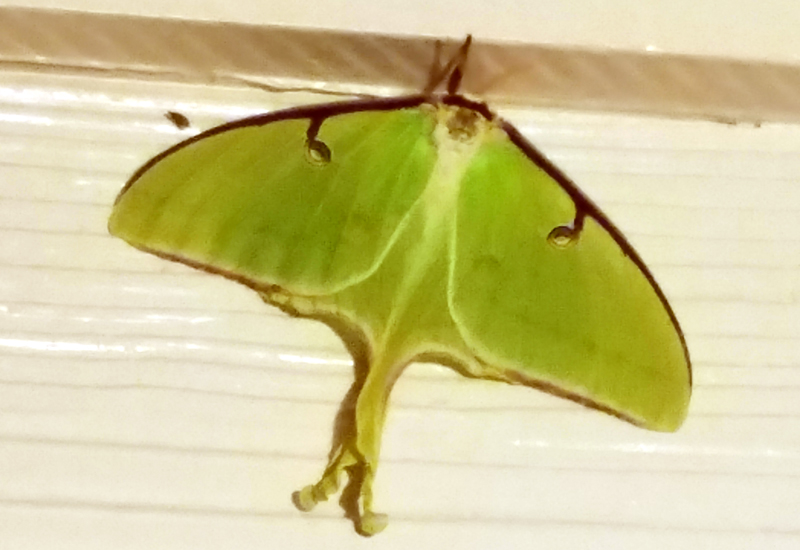
However, a common question that arises is whether luna moths are poisonous or not.
To answer this, it’s important to note that luna moths, scientifically named Actias luna, do not possess any venom or toxins that make them harmful to humans or other creatures.
They are considered safe to handle and observe, making them even more appealing to those interested in the world of insects.
Are Luna Moths Poisonous?
No, Luna moths are not poisonous.
Besides, luna moth caterpillars feed on the leaves of various tree species such as persimmon, sweetgum, walnut, and hickory1.
Despite their vibrant green appearance, they do not possess toxins or venom in their bodies2.
Luna Moth Caterpillar Characteristics:
- Vibrant green color
- No toxins or venom
- Feed on leaves from persimmon, sweetgum, walnut, and hickory trees
Harmless to Humans
Luna moths, native to the United States and Canada3, pose no threat to humans as they neither bite nor sting.
Adult moths have a short lifespan and are active at night4.
Comparing Luna Moth Caterpillar and Adult Moth
| Feature | Luna Moth Caterpillar | Adult Luna Moth |
|---|---|---|
| Threat to Humans | Harmless | Harmless |
| Toxins | None | None |
| Activity Time | Daytime | Nighttime |
Luna Moth Characteristics
Appearance
The Luna Moth showcases a striking appearance, characterized by its:
- Large size, with a 3-4.5-inch wingspan
- Sea-foam green to yellow color
- Long tails on hindwings
- Distinctive eyespots on all wings

Here’s a comparison of Luna Moth features to common moth characteristics:
| Feature | Luna Moth | Common Moth |
|---|---|---|
| Wingspan | 3-4.5 inches | 0.5-2 inches |
| Color | Green to yellow | Varied |
| Tails | Long on hindwings | Rare/shorter |
| Eyespots | On all wings | Rare/less distinct |
Life Cycle
The life cycle of the Luna Moth varies depending on location:
- Univoltine: one generation per year in areas like Michigan
- Bivoltine: two generations per year in the Ohio Valley region
- Trivoltine: three generations per year in southern regions
In each stage, the appearance of Luna Moths is different:
- Eggs: Small, white to translucent, and oval-shaped
- Larvae: Bright green caterpillars with yellow bands on each segment
- Pupa: Cocoon stage, wrapped in leaves
- Adult: Emerges with green wings, eyespots, and long tails on hindwings
Despite their magnificent appearance, Luna Moths are not known to be poisonous. They they are admired for their beautiful and distinctive features, as well as their fascinating life cycle.
Distribution and Habitat
Luna moths can be found throughout Eastern North America, with a distribution that spans from Canada to parts of the United States.
In the US, their range extends from Maine down to Florida and westward to Texas. They are also present in Nova Scotia, but their range does not extend as far west as Saskatchewan.
Preferred Environment
These large, green moths thrive in forested areas, where they have access to a variety of host plants for laying their eggs. Some common host plants include:
- Hickory
- Walnut
- Sweetgum
- Sumac
Luna moths have adapted to different environments within their range, resulting in varying numbers of generations per year.
In more northern areas like Michigan, they have one generation, while they have two generations in the Ohio Valley and up to three generations in the southern parts of their range.
Defense Mechanisms for Predators
The luna moth has developed several tactics to protect itself from predators. One such mechanism is its distinctive appearance, which helps it blend in with its surroundings.

Additionally, the moth has discal eyespots on both its fore and hind wings, allowing them to deter potential predators by appearing larger and more intimidating 1.
Luna moth caterpillars also employ a variety of defense mechanisms. These include:
- Distasteful fluid: Produced by caterpillars to deter predators.
- Clicking noise: Caterpillars make noise to startle and repel attackers.
They can produce a distasteful fluid that deters predators from consuming them 3. Moreover, these caterpillars can produce a clicking noise to startle and repel potential attackers 3.
Natural Enemies
Luna moths and their caterpillars face numerous predators in their natural habitat.
These predators include:
- Bats: They are attracted by the moth’s large size and presence in the night sky.
- Owls: Luna moths can be targeted by these nocturnal birds of prey.
- Fiery searcher ground beetles: These beetles can prey on luna moth caterpillars.
- Parasitic wasps: They can lay their eggs inside the caterpillars, eventually leading to the caterpillar’s death.
A crucial aspect of the luna moth’s interaction with predators such as bats involves the long tails on the moth’s hind wings 2.
These tails disrupt the sonar that hunting bats use to locate the moths, making it more difficult for them to catch their prey 2.
This evolutionary adaptation helps the luna moth evade predators and survive in its natural environment.
Impact on Ecology and Human Life
The relationship between Luna Moths and plants is primarily related to their larval stage.
The larvae feed on a variety of tree leaves, including walnut, hickory, and sweetgum. They typically don’t cause severe damage to the trees they inhabit.
In this way, Luna Moths are an important part of the ecosystem, as they help control plant populations and provide a food source for other animals.
Conservation Status
Luna Moths are not considered endangered or threatened. However, they face a few issues that could impact their populations:
- Habitat loss
- Pesticide use
- Climate change
Despite these challenges, Luna Moths continue to be a captivating and essential presence in North American ecosystems.
Conclusion
The captivating Luna moth, with its vibrant green beauty and unique features, dispels the myth of its poisonous nature. With no toxins or venom, these gentle insects pose no harm to humans or other creatures.
Their intricate defense mechanisms, remarkable life cycle, and role in the ecosystem make them a truly enchanting and cherished presence across North America.
Despite the challenges they face, Luna moths continue to be a symbol of nature’s resilience and the intricate interplay of species within our ecosystems.
Footnotes
- Luna Moth Caterpillar – Mountain Lake Biological Station ↩ ↩2
- Luna Moth – Missouri Department of Conservation ↩ ↩2 ↩3
- Luna Moth – Home & Garden Information Center ↩ ↩2 ↩3
- Luna Moth – Entomology and Nematology Department ↩


