The Anise Swallowtail is an enchanting butterfly belonging to the Papilio genus. It is known for its captivating presence and unique life cycle adjustments that align with its host plants’ seasonality.
Native to North America, these butterflies are often found in various habitats, including bare hills, mountains, fields, and gardens. Anise Swallowtails display a stunning color pattern, featuring yellow and black markings on their wings.
Furthermore, they are known to have an ecotype arrangement, with different populations adapting to their host plants’ seasonal changes.
This fascinating adaptation has helped them thrive in various environments across their geographic range.
To fully appreciate the Anise Swallowtail, one should take note of its remarkable traits:
- Yellow and black wing color pattern
- Found in diverse habitats
It is crucial to protect and conserve these beautiful butterflies to ensure their continued existence for future generations.

Anise Swallowtail: Overview
The Anise Swallowtail (Papilio zelicaon) is a beautiful butterfly native to western North America. It’s well-known for its striking appearance and affinity for various host plants.
Scientific Classification
- Kingdom: Animalia
- Phylum: Arthropoda
- Class: Insecta
- Order: Lepidoptera
- Family: Papilionidae
- Genus: Papilio
- Species: P. zelicaon
Physical Description
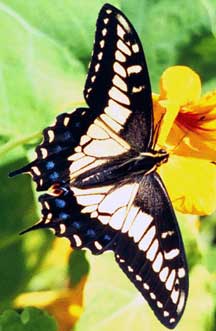
Anise Swallowtails are medium-sized butterflies with a wingspan of 52-80 mm (2.0 to 3.1 in). They exhibit a coloration pattern with yellow and black bands and blue, red, or orange spots near the bottom. Some distinctive features include:
- Yellow and black bands on wings
- Blue, red, or orange spots near the bottom of the wings
- A prominent “tail” on the hind wings

Distribution and Habitat
Anise Swallowtails are found throughout the western regions of North America – from Canada, throughout the United States, and down to Mexico, including the Baja California Peninsula.
As stated above, they are versatile in their habitat preferences and can be found in various environments such as:
- Woodland edges
- Rocky outcrops
- Desert canyons
- Suburban gardens
This adaptation to different habitats has led to a complex set of ecological races and interactions with various host plants.
Life Cycle and Behavior
Eggs
Anise Swallowtail eggs are:
- Round
- Yellow-green in color
Eggs are laid singly on host plants. They hatch in about 4-6 days, depending on temperature.
Larvae and Caterpillars
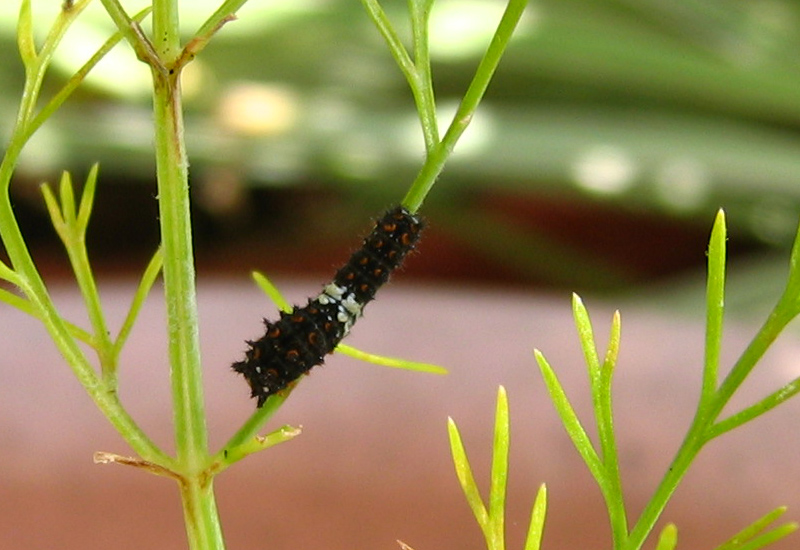
Anise Swallowtail larvae, or caterpillars, are:
- The first instar has a black body white stripes or white spots. At the fifth instar, they become green with black and yellow stripes.
- Black bands on their body
- Red eyespots
They develop through various stages, called instars. Anise Swallowtail caterpillars:
- Eat host plant leaves when young
- Consume inflorescences when older
- Build no nest
- Wander for up to 24 days before pupating

Pupa and Chrysalis
Pupa stage:
- Called chrysalis
- Dark black pupil
- Attached to a branch using silk
Anise Swallowtail pupa overwinters, meaning it undergoes metamorphosis during winter.

Adult Butterfly
Anise Swallowtail adult butterfly features:
- Wingspan of up to 3.1 inches
- Black with yellow, blue, orange, and red markings
| Feature | Anise Swallowtail |
|---|---|
| Wingspan Range | 2.0 to 3.1 in |
| Adult Coloration | Black, Yellow, Blue, Orange, Red |
Identification and Differences
Western Tiger Swallowtail
The Western Tiger Swallowtail (Papilio rutulus) is a large butterfly, characterized by its vibrant yellow and black stripes. Key features include:
- Yellow and black striping patterns on the wings
- Blue spots along the lower edge of the hindwing
- Striking resemblance to the Anise Swallowtail
Comparing Anise Swallowtail and Western Tiger Swallowtail:
| Features | Anise Swallowtail | Western Tiger Swallowtail |
|---|---|---|
| Yellow Stripes | Thin, narrow, evenly spaced | Wider, sometimes uneven |
| Vertical Black Striping Pattern | Absent | Present |
| Blue Spots | Along the edge of the hindwing, small | Across the lower hindwing, larger |
Subspecies of Anise Swallowtail
Multiple subspecies of Anise Swallowtail (Papilio zelicaon) exist, each adapted to specific ecological regions based on their host plants.
Key characteristics of Anise Swallowtail and subspecies variation:
- The yellow band along the hindwing edge varies in width
- Blue spots, size, and intensity may differ among subspecies
- Black stripes on the forewing and hindwing
For example, the subspecies Papilio zelicaon Nitra has a solid black-to-blue swallowtail. Recognizing these differences among subspecies will enhance your butterfly identification skills.

In conclusion, identifying the Anise Swallowtail and its related subspecies involves observing the distinct stripe patterns, blue spots, and yellow bands on their wings.
Comparing them to the Western Tiger Swallowtail will aid in differentiating them more accurately.
Host Plants and Diet
Apiaceae Family
The Anise Swallowtail butterfly primarily feeds on plants from the Apiaceae family. This family, also known as the carrot family, consists of several species that act as host plants for the Anise Swallowtail caterpillar, which include:
- Fennel
- Parsley
- Carrot
These plants provide essential nutrients for the caterpillar’s growth and development.

Rutaceae Family
Another significant host family for the Anise Swallowtail is the Rutaceae family, also known as the citrus family. This family comprises various citrus trees, which serve as additional host plants for the caterpillar.
Examples of Rutaceae family host plants include:
- Orange trees
- Lemon trees
- Lime trees
These trees offer an alternative food source and habitat for the Anise Swallowtail caterpillar.
Comparison Table:
| Apiaceae Family | Rutaceae Family | |
|---|---|---|
| Example 1 | Fennel (Sweet Fennel) | Orange Trees |
| Example 2 | Parsley | Lemon Trees |
| Example 3 | Carrot | Lime Trees |
| Benefits | Wide range of plants | Offers alternative hosts |
In conclusion, Anise Swallowtail butterflies rely on both Apiaceae and Rutaceae families as host plants for their caterpillars. Planting these species in a garden can help support the Swallowtail butterfly populations.
Conservation and Gardening
Creating a Butterfly-Friendly Garden
An Anise Swallowtail-friendly garden needs:
- Host plants: Anise swallowtails lay eggs on plants like Illicium parviflorum, a licorice-scented shrub native to the southeastern United States.
- Nectar sources: Adult swallowtails feed on flower nectar. Plant a variety of flowering plants, mixing colors and shapes, to attract them.
- Shelter: Butterflies need safe resting spots, such as tall grasses, vegetation near the ground, or garden sheds.
NatureServe Conservation Status
NatureServe ranks butterfly species based on their level of risk. The Anise Swallowtail Papilio zelicaon has not yet been ranked. However, it occurs in diverse habitats, such as open areas, roadsides, and bare hills.
This adaptability suggests a degree of resilience in the face of habitat changes.
| Butterfly Species | NatureServe Status |
|---|---|
| Anise Swallowtail | Not Ranked |
| Black Swallowtail | G5 (Secure) |
| Florida Anise | G4 (Apparently Secure) |

Interesting Facts and Trivia
The Anise Swallowtail is a fascinating butterfly species that belongs to the Papilionidae family. Here are some captivating facts about this butterfly:
- As a member of the swallowtail group, the Anise Swallowtail has tail-like extensions on its hind wings.
- Their striking appearance includes a combination of black, yellow, and blue colors on their wings.
- Anise Swallowtail larvae are known for their bird droppings-like appearance as a camouflage technique
Finally, here’s a comparison table that highlights the differences between Anise Swallowtail and Black Swallowtail, another popular species:
| Characteristic | Anise Swallowtail | Black Swallowtail |
|---|---|---|
| Wing Colors | Black, Yellow, Blue | Black, Yellow, Blue, Orange |
| Habitat Preferences | Mountains, Coastal Areas | Open Areas, Meadows |
| Host Plants | Fennel, Parsley, Dill | Parsley, Dill, Carrot |
Conclusion
The Anise Swallowtail is a remarkable creature that is not only beautiful but also plays a vital role in the ecosystem. Its stunning appearance, diverse habitat preferences, and unique life cycle adaptations make it a species worth protecting and preserving for future generations.