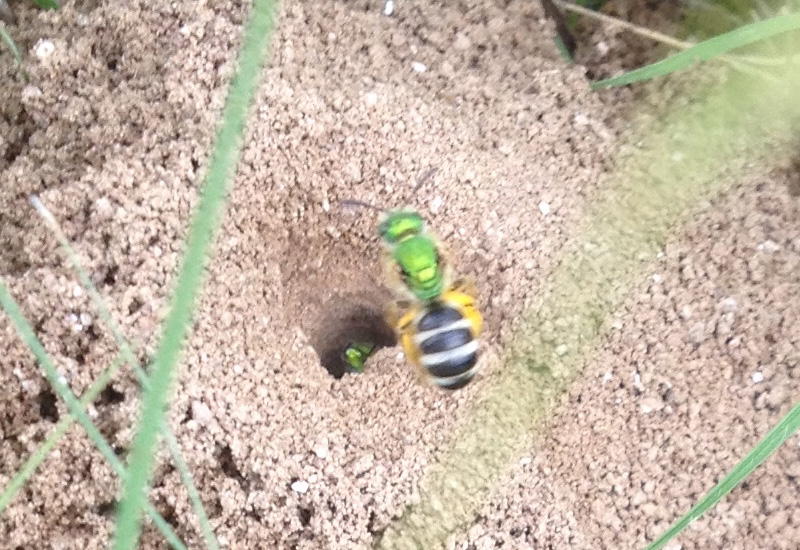
The Metallic Green Bee, also known as Agapostemon virescens, is a striking bee species that can be found in gardens throughout the Midwestern and Northeastern United States. With its vibrant green color, this eye-catching insect is not only a fascinating creature to observe but also a vital pollinator for various plants in your garden.
These green bees have a fascinating life cycle, with preferences for specific flowers and a remarkable appearance. Their beautiful metallic hue and dark, transparent wings make them stand out among other bee species. The Metallic Green Bee contributes to the ecosystem and encourages biodiversity by pollinating different types of flowers.
Basic Characteristics
Size
Metallic green bees are generally small to medium in size, typically ranging from 0.2 to 0.5 inches (5 to 12 mm) in length. Their compact size aids them in accessing a variety of flowers for nectar and pollen foraging.
Color
These insects exhibit bright, striking colors that set them apart from other bees. Their hues include:
- Metallic green: A stunning and common color variation found in many species, like the Augochlora pura.
- Blue: Some metallic green bees may have slight bluish undertones or even appear almost blue in certain lighting conditions.
Appearance
These bees are not only captivating in color but also have distinct physical features.
- Bodies: Metallic green bees have a compact body structure with noticeable hair, giving them a fuzzy appearance.
- Sexual dimorphism: There are some differences between males and females. Males often have longer antennae and slimmer bodies, while females are more robust and have structures for collecting pollen on their hind legs.
Metallic Green Bee vs. Bumblebee
| Feature | Metallic Green Bee | Bumblebee |
|---|---|---|
| Size | 0.2 to 0.5 inches (5-12mm) | Larger, up to 0.9 inches (23mm) |
| Color | Metallic green, blue | Dark brown, black with bright yellow or orange stripes |
| Appearance | Compact, fuzzy body | Round, fuzzy body |
Appealing Traits of Metallic Green Bees:
- Striking coloration
- Efficient pollinators
- Diverse habitat preferences
Species and Distribution
North America
Metallic green bees are found throughout North America, particularly in the United States. One common example is the Agapostemon virescens, a striking green bee which mainly inhabits the Midwestern and Northeastern regions of the country, but can be spotted coast to coast.
Another North American species is the Agapostemon melliventris, found across the United States and parts of Canada.
South America
In South America, one notable metallic green bee species is the Augochlora, which belongs to the family Halictidae.
Central America
Similarly, Central America is home to various metallic green bee species. The green carpenter bee, found in tropical regions, is one example.
Here’s a brief overview of these bee species:
| Region | Species Example | Bee Family |
|---|---|---|
| North America | Agapostemon virescens | Halictidae |
| North America | Agapostemon melliventris | Halictidae |
| South America | Augochlora | Halictidae |
| Central America | Green Carpenter Bee | Halictidae |
Some key features of metallic green bees are:
- Bright metallic-green coloration
- Varying sizes, often similar to or slightly smaller than a honeybee
- Found in diverse habitats, including gardens and tropical regions
Distinctive characteristics include:
- Ground-nesting or twig-nesting behaviors
- Attraction to various flower types for pollination
- Interaction with other insects and plants in their ecosystems
Habitats and Interactions with Plants
Preferred Habitat
The metallic green bee, also known as Agapostemon virescens, is found predominantly in the Midwestern and Northeastern United States. However, there have been sightings from coast to coast. They reside mainly in gardens, meadows, and open woodlands.
Flowering Plants
These bees have a liking for native flowering plants, including:
- Aster flowers
- Goldenrod
- Bee balm
Their attraction to flowers, rich in nectar and pollen, makes them essential pollinators.
Pollination Roles
The metallic green bee plays an important role in the pollination of various flowering plants. They help in:
- Plant reproduction
- Genetic diversity improvement
- Increased fruit and seed production
A quick comparison of metallic green bees to honeybees:
| Comparison Aspect | Metallic Green Bee | Honeybee |
|---|---|---|
| Habitat | Gardens, meadows, open woodlands | Beehives, apiaries |
| Pollination Role | Strong pollinators of native plants | Generalist pollinator |
| Social Behavior | Solitary pollinator, single nests | Lives in colonies |
| Behavioral Difference | More likely to visit a variety of plants | Less plant variety |
Being solitary pollinators and visiting numerous plant species, metallic green bees contribute uniquely to plant and flower diversity.
Social Structure and Nesting
Solitary vs. Social Behavior
Metallic green bees are solitary bees, meaning they do not form colonies like honey bees or bumble bees. Each female metallic green bee is responsible for her own nest and offspring. This differs from social bees, which have a division of labor among worker bees, drones, and the queen.
Nest Construction
Solitary metallic green bees construct their nests underground in soil, creating tunnels that contain multiple cells. Each cell houses a single developing larva. Nest building is an essential part of the metallic green bee’s life cycle and involves excavating soil and burrowing into the ground.
Mating and Reproductive Habits
- Female bees mate once and store sperm for their entire life.
- Male bees primarily look for females to mate with.
- Males are territorial and protect their chosen flowers.
Female metallic green bees lay eggs in the cells of their nests. Before sealing up each cell, the female provides a mixture of pollen and nectar, which serves as food for the developing larva. Once the larva has consumed this food, it will pupate and eventually emerge as an adult bee with fully developed wings.
Comparing Solitary and Social Bees:
| Feature | Solitary Bee | Social Bee |
|---|---|---|
| Nesting | Individual nests | Shared colonies |
| Mating | Mate once; females lay their own eggs | Division of labor among caste members |
| Behavior | Non-aggressive | Territorial |
Threats and Conservation
Predators
Metallic Green Bees (Agapostemon virescens) have various predators, including:
- Birds
- Spiders
- Praying mantises
These predators can significantly impact bee populations.
Pesticides and Human Impacts
Exposure to pesticides, particularly those used in agriculture, poses a significant threat to Metallic Green Bees. For example, neonicotinoids can negatively affect the bees’ ability to forage and reproduce.
Human activities, such as habitat destruction and urbanization, also contribute to the decline of bee populations.
| Impact | Example |
|---|---|
| Pesticide | Neonicotinoids |
| Human Activity | Habitat Destruction |
Benefits to Ecosystems
Metallic Green Bees are crucial to ecosystems. They are:
- Effective pollinators
- Contributing to the growth of vegetables and fruits
- Support biodiversity in meadows and other environments
Entomologists and other scientists recognize the need for conserving these beneficial insects.
Comparison to Other Bees and Wasps
Carpenter Bees
Carpenter bees are large, shiny, black, and yellow bees. They’re known for drilling holes into wood surfaces. Some key differences between carpenter bees and metallic green bees include:
- Size: Carpenter bees are larger than metallic green bees.
- Color: Carpenter bees are black and yellow, while metallic green bees have bright, metallic-green coloration.
For instance, sawdust piles below perfectly circular holes indicate the presence of carpenter bees, whereas metallic green bees don’t cause such damage.
Orchid Bees
Orchid bees, belonging to the genus Euglossa, are also bright metallic green. They share similar features with metallic green bees, such as:
- Size: Both bees are roughly the same size, about 1.3 cm in length.
- Color: Both have bright, metallic-green coloration.
However, orchid bees are rare and found mainly in Central and South America, while metallic green bees are found in the United States.
Mason Bees
Mason bees belong to the Osmia genus and are small, solitary bees often with metallic coloration. Differences with metallic green bees include:
- Color: Mason bees can have a metallic-blue color, different from the green of metallic green bees.
- Nesting: Mason bees build nests using mud or clay, unlike metallic green bees.
An example can be found in the blue orchard mason bee which is beneficial for pollination.
Differences in Aggression
Comparing aggression levels between bees and wasps:
| Species | Aggression Level |
|---|---|
| Metallic Green Bee | Low |
| Carpenter Bee | Low |
| Orchid Bee | Low |
| Mason Bee | Low |
| Wasps | Moderate to High |
| Hornets | High |
Metallic green bees and other bee species mentioned are generally non-aggressive and focused on pollinating flowers. Wasps and hornets can be more aggressive, especially when their nests are disturbed. They have a smooth body, as opposed to bees’ hairy bodies, and the potential to sting multiple times.
Unique Features and Trivia
Salt Collection
Metallic green bees, like many other bee species, are known to collect salt from various sources, such as sweat or soil. They use their proboscis to drink salt-laden liquid, which provides essential nutrients for their body functions. Here are some examples:
- Drinking sweat from human skin
- Gathering salt from the soil surface
Atypical Bee Characteristics
Green sweat bees, such as the honey-tailed striped sweat bee (Agapostemon virescens) and Augochloropsis metallica, exhibit some peculiar traits that set them apart from other bees:
- Generalists: These bees are not picky and can pollinate a wide variety of flowers.
- Winter behavior: Unlike most bees that hibernate or die off during winter, some green sweat bees like Augochloropsis metallica can be found in Florida where they remain active throughout the winter months.
- Parasitic bees: Some metallic green bee species are known as “cuckoo bees” due to their kleptoparasitic behavior, where they lay their eggs in the nests of other bee species.
Below is a comparison table of generalist and specialist bees:
| Trait | Generalist Bees (e.g. Green Sweat Bees) | Specialist Bees |
|---|---|---|
| Flower preference | Wide variety of flowers | Specific types of flowers |
| Pollination efficiency | May be less efficient | Highly efficient for their preferred flowers |
Expert Opinions
According to experts, metallic green bees exhibit striking physical features. The head, thorax, and abdomen of these bees are typically covered in vibrant, iridescent green or blue hues. The appearance of metallic green bees can vary slightly based on their species and location.
In conclusion:
- Green sweat bees collect salt for their nutritional needs.
- They differ from other bees in their generalist behavior, winter activity, and in some cases, parasitic lifestyles.
- Metallic green bees have a unique, beautiful appearance with iridescent green or blue coloration.