Ichneumon wasps are fascinating creatures belonging to one of the largest insect families, with over 4,000 species found across North America. These insects display a diverse range of forms, sizes, and colorations, making them an intriguing topic. While they share similarities with stinging wasps, ichneumons generally have a more slender build, longer antennae, and distinctive ovipositors in females.
The name “ichneumon” has Greek origins, meaning “tracker” and “footprint”, which is fitting considering the female wasps’ ability to hunt and track their prey. Ichneumon wasps are parasitic, meaning their larvae develop inside the bodies of other insects. This unique behavior makes them excellent natural pest control agents, as they help limit populations of potential pests.
Ichneumon wasps can be found in a wide variety of habitats and play a significant role in maintaining the balance of their ecosystems. Understanding the biology, behavior, and ecology of these insects provides valuable insights into the diverse world of invertebrates they inhabit. With thousands of species to study, the ichneumon wasp family holds countless opportunities for exploration and discovery.
Ichneumon Wasp Overview
Identification Features
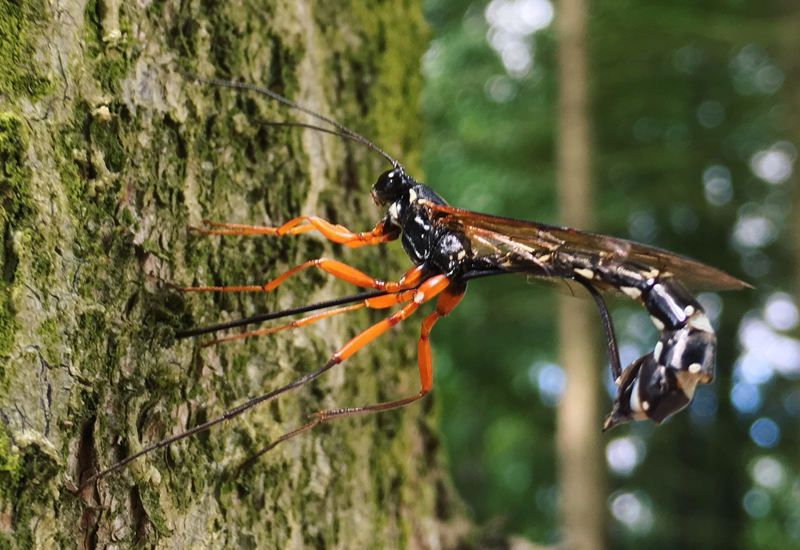
Ichneumon wasps are a type of insect belonging to the family Ichneumonidae and order Hymenoptera. These slender wasps have several characteristic features that make them stand out:
- Long, jointed legs
- A narrow waist
- Two pairs of wings
- A long, slender abdomen
- Long antennae
Size and Appearance
Ichneumon wasps have varying sizes, typically ranging from about 1/10″ to 1 1/2″ long. One species, Megarhyssa, can be nearly 3″ long including its very long tail-like ovipositor.
Colors and Patterns
These wasps exhibit a wide range of colors and patterns. Some have brightly colored bands on their abdomens, while others have more subtle markings. Many species have a sickle-shaped abdomen.
Family Ichneumonidae
Ichneumonidae is the largest family within the insects, with an estimated 60,000 to 100,000 species worldwide. The name “ichneumon” comes from Greek words meaning “tracker” and “footprint,” which relates to the hunting behavior of these parasitic wasps.
Order Hymenoptera
Order Hymenoptera consists of various types of insects, including bees, ants, sawflies, and wasps like the ichneumon wasp. They share some common features, like:
- Two pairs of wings, with the front pair larger than the back pair
- Abdomen connected to thorax by a narrow waist
- Females typically possessing an ovipositor, used for laying eggs.
Comparison Table: Ichneumon Wasp vs. Other Hymenoptera Insects
| Feature | Ichneumon Wasp | Bees | Ants |
|---|---|---|---|
| Size | 1/10″ – 3″ | 1/8″ – 1 1/2″ | 1/16″ – 1″ |
| Legs | Long, jointed legs | Shorter, jointed legs | Shorter, jointed legs |
| Waist | Narrow, slender waist | Broad waist | Narrow, slender waist |
| Color | Varied, can have bands | Mostly black/yellow or brown | Mostly brown, black or reddish |
| Behavior | Parasitic, hunts for hosts | Pollinators, social | Social, display complex behaviors |
Ichneumon wasp has many distinctive features and behaviors, placing it among the fascinating insects within the family Ichneumonidae and order Hymenoptera.
Life Cycle and Reproduction
Egg Laying and Hosts
Ichneumon wasps are known for their unique reproduction process. Female ichneumons use their ovipositor to inject eggs into a host’s body, typically a grub, caterpillar, or pupa1. Examples of host species include:
- Wood-boring insects’ larvae
- Larval pigeon tremex (a type of horntail wasp)2
Many Ichneumon wasps are specific to certain host species, ensuring they lay their eggs in particular environments suitable for their offspring’s survival.
Larvae Development
Once inside the host, ichneumon wasp larvae feed on the host’s body, eventually killing it. The development period varies depending on the wasp species and host type. Some important aspects of larvae development include:
- Parasitism: Ichneumon wasp larvae are parasitic, depending on the host for nourishment and survival.
- Environment: The host provides a suitable environment for the larvae to grow and transition into the pupa stage.
- Host protection: Larvae might release chemicals to protect the host from other parasitic invasions, ensuring sufficient resources3.
Defining characteristics of ichneumon wasp larvae:
- Feed on host’s body
- Borrow sustenance from host
Pupa Stage
After fully consuming the host, ichneumon wasp larvae pupate, usually within the host’s body or inside a self-created cocoon. Key features of the pupa stage:
- Transformation: The larvae transform into adult wasps
- Duration: The duration in the pupa stage varies between species and environmental factors
Pros and cons:
Pros:
- Secured environment: The cocoon provides protection
- Optimal conditions: Pupation occurs when conditions are suitable
Cons:
- Longer development: Transitioning to an adult may take time
- Host-dependency: Relying on a specific host species makes them vulnerable to host population decline
Some ichneumon wasps emerge from the pupal stage as early as a few weeks, while others may take up to a year4. The adult wasps ultimately continue their life cycle by seeking new hosts and repeating the process.
Behavior and Interaction with Other Species
Parasitic Relationship with Hosts
Ichneumon wasps are known for their parasitic behavior with other insects, primarily targeting flies, beetles, moth and butterfly larvae as hosts for their eggs. They exhibit a remarkable ability to locate and inject their eggs into their hosts, typically within wood-boring insects or leaf-eating caterpillars. Some examples of host insects include:
- Wood borers
- Land invertebrates
- Arthropods
Upon hatching, the wasp larvae feed on the host’s body, eventually causing its demise.
Predators and Preys
These wasps are considered beneficial insects as they play a vital role in controlling the population of various pests in gardens and forests. Although they are parasites to other insects, they themselves can become prey to larger predators such as birds and spiders. Ichneumon wasps also feed on nectar and pollen from flowers, making them important pollinators.
Interactions with Humans and Gardens
Most ichneumon wasps are harmless to humans, as their venomous sting is mainly used to paralyze their host. They can be an essential part of a garden’s ecosystem by providing natural pest control. Encouraging their presence can be done by planting diverse flower varieties to attract them with nectar and pollen.
Here is a comparison table of parasitic wasps and other insects:
| Characteristic | Ichneumon Wasps | Other Insects |
|---|---|---|
| Biological Role | Beneficial Parasite | Varies |
| Prey Types | Caterpillars, wood borers, etc. | Varies |
| Ability to sting or harm humans | Limited | Varies |
Overall, understanding the behavior and interactions of ichneumon wasps with their environment, hosts, and humans can help to appreciate their importance in maintaining balance within ecosystems and gardens.
Habitat and Distribution
North American Species
The Ichneumon Wasp is found in various habitats across North America. Some of the 4,000 species in this region live in places like Missouri. They coexist with different insects:
- Ants
- Bees
Comparison of Ichneumon Wasp with Ants and Bees:
| Features | Ichneumon Wasp | Ants | Bees |
|---|---|---|---|
| Body Structure | Slender | Segmented | Plump |
| Antennae Length | Long (16+ segments) | Elbowed | Short |
| Role | Parasitic | Social | Pollination |
Other Regions
This family of wasps is extensive, boasting around 60,000 worldwide species. As one of the largest animal species groups, they thrive in nearly all habitats.
Notable Ichneumon Wasp Species
Megarhyssa Macrurus
Megarhyssa Macrurus, also known as the giant ichneumon wasp, is a large species belonging to the family Ichneumonidae and order Hymenoptera. Some key features include:
- Female stinger and long ovipositor used for laying eggs
- Parasitizes horntails wood wasps
- Does not pose a threat to humans
This species is particularly efficient in parasitizing horntails, as its long stinger allows it to penetrate wood and lay eggs in horntail larvae.
Trichogramma Wasp
Trichogramma wasps are tiny but effective predators of herbivorous insects, especially caterpillars. They can be used as a biological control method in agriculture. These wasps:
- Lay eggs inside the eggs of other insects
- Control pests, such as tomato hornworms
- Are sensitive to temperature changes
Trichogramma wasps can be adversely affected by temperature fluctuations, which can impact their efficiency as predators.
Clothes Moths Parasites
Certain Ichneumon wasps act as parasites for clothes moths, which are notorious for damaging garments stored in closets. Key characteristics of these wasps include:
- Tiny size
- Specialized ovipositor for penetrating moth eggs
- Reduction in moth populations
Their specialization has a positive impact on reducing the number of clothes moths, thereby preventing damage to garments.
Tomato Hornworms and Boll Weevils Predators
Ichneumon wasps prey on a variety of herbivorous insects, including tomato hornworms and boll weevils. These predatory wasps are helpful in controlling populations of these pests, which can cause significant damage to crops.
Here is a comparison table listing these species:
| Wasp Species | Target Pests |
|---|---|
| Megarhyssa Macrurus | Horntails |
| Trichogramma Wasp | Caterpillars, including tomato hornworms |
| Clothes Moths Wasps | Clothes moths |
| Tomato Hornworms Wasps | Tomato hornworms and boll weevils |
Footnotes
- Life Cycle of Ichneumon Wasp ↩
- Long-Tailed Giant Ichneumon Wasp ↩
- Ichneumonoid Wasp Overview ↩
- Ichneumon Wasp Species ↩




 .
.


