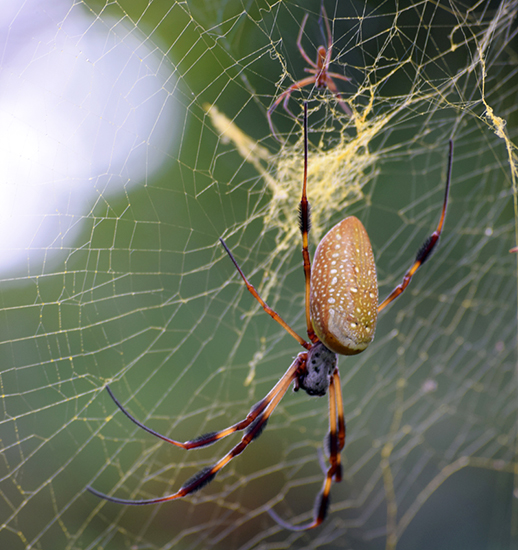
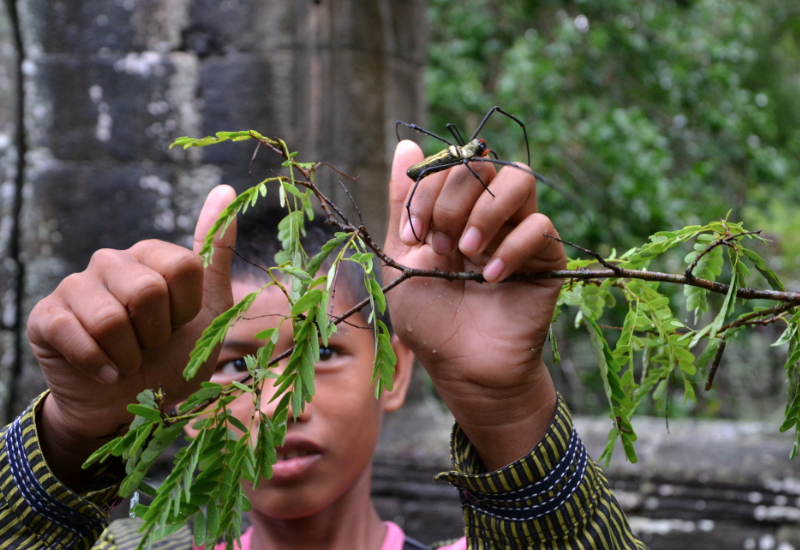
The Golden Silk Spider, scientifically known as Trichonephila clavipes, is a fascinating species native to southeastern states like Florida. These large spiders exhibit striking orange and brown hues and are easily recognizable due to the feathery tufts on their legs.
They are known for creating beautiful, golden-colored webs during the late summer and fall seasons. Despite their captivating appearance, Golden Silk Spiders can be a nuisance for hikers and hunters who often encounter their large webs in densely vegetated areas.
Some key features of the Golden Silk Spider include:
- Large size (females usually larger than males)
- Orange and brown coloration
- Feathery tufts on legs
- Golden silk webs
A comparison of Golden Silk Spiders to their closely related cousin, the East Asian Joro Spider, highlights some similarities and differences. Both species belong to the group of large spiders called golden orb-web weavers and make enormous, multi-layered webs of gold-colored silk. However, the Joro Spider is native to East Asia, while the Golden Silk Spider is found across the southeastern United States 1.
Golden Silk Spider Identification
Color and Size
The Golden Silk Spider, also known as Trichonephila clavipes or the Golden Silk Orb-Weaver, is a large spider known for its distinct colors. The spider exhibits a combination of orange, yellow, and brown hues, especially on its abdomen. The females are notably larger than the males.
For example:
- Female body length: 24-40mm
- Male body length: 5-6mm
Physical Characteristics
Here are some notable physical characteristics of the Golden Silk Spider:
- Abdomen: The abdomen is elongated and contains yellow spots on a dark brown background.
- Legs: The spider has eight legs with a unique appearance, featuring feathery tufts of hair on their surface.
The chart below compares some key aspects of the Golden Silk Spider’s appearance.
| Characteristic | Description |
|---|---|
| Color | Orange, Yellow, and Brown |
| Abdomen | Elongated with yellow spots on a dark brown base |
| Legs | Eight legs with feathery tufts of hair |
In summary, you can identify a Golden Silk Spider by its distinctive color, elongated abdomen with yellow spots, and hairy legs.
Habitat and Distribution
United States and Central America
The Golden Silk Spider, Trichonephila clavipes, is commonly found in the southeastern United States, particularly in states like Florida and North Carolina.
In Central America, their distribution extends to countries like Guatemala and Panama.
- Preferred habitat: They typically inhabit warm, humid environments, such as gardens and forests.
South America and the Pacific
In South America, the Golden Silk Spider ranges from countries like Argentina to the northwestern coast.
Their habitat extends to the far reaches of the South Pacific, including islands such as Madagascar and New Guinea.
- Versatility: These spiders adapt well to various environments, from tropical rainforests to dry deserts.
| Region | Distribution | Examples |
|---|---|---|
| United States | Southeastern states | Florida, North Carolina |
| Central America | Through Panama | Guatemala, Panama |
| South America | Northwestern coast | Argentina |
| South Pacific | Islands, Madagascar | Madagascar, New Guinea |
- Key Features:
- Inhabit warm, humid environments
- Adapt well to various environments
Web and Silk Properties
Structure and Appearance
The golden silk spider, also known as an orb-weaving spider, creates a unique type of web that displays an asymmetrical orb shape. The spider typically waits near the top of the web, making it a semi-permanent structure 1. The web itself has a signature golden hue, hence the name “golden silk spider” 2.
- Unique asymmetrical orb structure
- Semi-permanent (not destroyed periodically)
- Distinctive golden hue
Strength and Applications
Spider silk, especially from the golden silk spider, is known for its exceptional strength and stretchiness. These properties make it resilient and one of the strongest materials known 3. In comparison to steel, spider silk of the same weight has greater tensile strength 4. Here are some applications of spider silk:
- Web building and capturing prey
- Sperm transfer in reproduction
- Lining hibernating, molting, or living chambers
- Constructing egg cases
- Draglines and mating bowers
- Wind-borne travel in spiderlings
The versatility of spider silk offers potential uses in various fields, such as creating fishing nets (due to its strength and underwater durability), as well as in medical advancements (biodegradability and biocompatibility with human tissues) 5.
Comparison Table
| Material | Strength | Stretchiness | Applications |
|---|---|---|---|
| Steel | Strong | Low | Construction, infrastructure, automotive and aviation |
| Spider Silk | Exceptional (Greater than steel at equal weight) | High | Web building, prey capture, reproduction, living chambers, egg cases, draglines, mating bowers, potential medical applications |
Diet and Prey
The Golden Silk Spider, also known as the Trichonephila clavipes, has a preference for flying insects as its primary source of nourishment. These spiders are experts at catching a variety of winged victims.
Flying Insects
Golden Silk Spiders typically target:
- Flies
- Bees
- Mosquitoes
- Butterflies
- Dragonflies
- Grasshoppers
These skilled predators craft their webs to strategically capture their prey. Once ensnared, they immobilize the insect by injecting venom.
Comparison Table
| Prey | Attraction for Spiders | Cons for Spiders |
|---|---|---|
| Flies | Abundant and easy to catch | Lower nutritional value |
| Bees | Nutritious and high in protein | Can potentially sting the spider |
| Mosquitoes | Widespread, especially in humid areas | Smaller size, less sustenance |
| Butterflies | Visually appealing prey | Might escape due to size |
| Dragonflies | Good source of protein | Difficult to catch, strong wings |
| Grasshoppers | Large and filling | Might escape because of size |
The Golden Silk Spider’s diet is diverse and opportunistic. They take advantage of their environment to feed on a wide range of flying insects, ensuring a consistent source of nutrients.
Reproduction and Life Cycle
Mating Behavior
Golden Silk Spiders exhibit fascinating mating rituals. Males are much smaller than females, and they approach females with caution. They perform a delicate dance on the web to avoid being mistaken for prey and eaten by the female. Males also deposit their sperm onto the female’s abdomen, using a specialized organ called a pedipalp.
Eggs and Offspring
Female Golden Silk Spiders, also known as Banana Spiders, lay their eggs around August or September. They create a protective egg sac made of silk and cover it with a layer of their golden silk. Some key features of their reproduction are:
- Females can lay up to 3,000 eggs in one sac
- Egg sacs are about the size of a small orange
- The color of the egg sac helps camouflage it among leaves
Adult females guard their egg sacs to ensure the survival of their offspring. The baby spiders or spiderlings hatch within a few weeks and are covered in a dense layer of fine hair. They remain close to the egg sac until they are ready to disperse and build webs of their own.
Comparison Table
| Females | Males | |
|---|---|---|
| Size | Larger (body length up to 1.5 inches) | Smaller (body length 0.2-0.35 inches) |
| Color | Brighter, often yellowish-orange with black markings | Duller, typically brownish or grayish |
| Role | Build webs, lay eggs, guard offspring | Transfer sperm, dance to attract females |
It’s important to note that Golden Silk Spiders are generally not harmful to humans. Their venom can cause localized pain and redness, similar to a bee sting, but it’s not severe or dangerous unless the person is allergic. The spiders will bite only if threatened or mishandled.
Human Interaction
Encounters and Safety Precautions
People often encounter the Golden Silk Spider during the late summer and fall in southeastern states. The spiders commonly build their large golden webs in low shrubs, where hikers and hunters might come across them. To avoid unpleasant encounters with these spiders:
- Be observant while walking in wooded areas
- Carry a walking stick to clear webs ahead of you
- Wear long sleeves and pants to protect your skin
Medical Significance
The Golden Silk Spider is not venomous, and its bite is considered harmless to humans. However, if bitten, some individuals may experience localized pain and redness at the bite site. Comparing this species to other spiders, the Golden Silk Spider is less likely to cause medical concerns:
| Spider Type | Bite Effects | Medical Concern |
|---|---|---|
| Golden Silk Spider | Localized pain, redness | Low |
| Brown Recluse | Necrosis, severe pain | High |
| Black Widow | Neurotoxic, severe pain | High |
In most cases, a bite from a Golden Silk Spider does not require medical attention, and over-the-counter pain relief can manage the symptoms. Remember, it’s essential to:
- Remain calm and avoid panicking if bitten
- Keep the bite area clean with soap and water
- Apply a cold compress to the bite site to reduce swelling and pain
- Consult a medical professional if the symptoms worsen or don’t subside after a day or two
Importance for Ecosystem
The Golden Silk Spider, also known as Trichonephila clavipes, plays a crucial role in maintaining the ecosystem balance. One of its main contributions lies in pest control.
- It feeds on various insects, including mosquitoes and flies.
- By consuming these pests, it helps reduce their population, ultimately improving human health and crop production.
The protein found in these spiders is also noteworthy. Their silk glands produce a unique, liquid protein, which turns into exceptionally strong and elastic fibers when stretched. Spider silk has impressive properties:
- Greater tensile strength than steel of the same weight.
- Highly elastic, which means it can stretch without breaking.
Due to its extraordinary features, researchers are interested in utilizing spider silk for various applications. Potential transportation improvements include:
- Lightweight, strong materials for vehicles and aircraft.
- Developing impact-resistant windshield glass.
A comparison between the silk of Golden Silk Spider and steel:
| Material | Tensile Strength | Elasticity | Weight |
|---|---|---|---|
| Golden Silk Spider Silk | High | High | Light |
| Steel | High | Low | Heavy |
To summarize, the Golden Silk Spider contributes significantly to ecosystem balance, pest control, and novel material development for various industries. Its exceptional silk properties offer exciting opportunities for future innovations.
Conservation and Threats
The Golden Silk Spider, also known as Trichonephila clavipes, is a large orange and brown spider found in Florida and other southeastern states1. Although it may be despised by hikers and hunters for its large golden webs, this fascinating creature plays a vital role in maintaining the ecosystem balance.
Molting
Molting is a process in which the spider sheds its exoskeleton to grow larger. This is a vulnerable time for the Golden Silk Spider, as it is more prone to predation and environmental threats. Understanding molting can help in conservation efforts for this species.
Threats
Some of the threats faced by the Golden Silk Spider include:
- Habitat loss
- Pesticide exposure
- Climate change
Conservation
To protect the Golden Silk Spider, various measures can be taken:
- Limit pesticide use in their native habitats
- Preserve and restore natural ecosystems
To understand the importance of these conservation efforts, let’s compare their benefits and drawbacks.
| Conservation Efforts | Pros | Cons |
|---|---|---|
| Limit pesticide use | Protect spiders and other species | May affect crop protection |
| Preserve ecosystems | Maintain biodiversity | Requires resources and funding |
In conclusion, the Golden Silk Spider plays an essential role in our ecosystem. Understanding its threats and taking relevant conservation measures is crucial to protect this striking species.
Golden Silk Spider vs Other Species
Argiope Aurantia
Argiope aurantia, also known as the black and yellow garden spider, is a showy spider often noticed in late summer. The females have a body length of just over one inch. Some key features of Argiope aurantia include:
- Orb-weaver spider
- Bright color pattern
- Trademark zig-zag pattern in web
In contrast to the golden silk spider, Argiope aurantia has a more pronounced color pattern and a smaller body size.
Comparison of Golden Silk Spider and Argiope Aurantia:
| Feature | Golden Silk Spider | Argiope Aurantia |
|---|---|---|
| Body length | Larger than Argiope Aurantia | Approximately 1 inch |
| Color pattern | Orange and brown hues | Bright black and yellow |
| Web construction | Large golden webs | Zig-zag pattern in center |
Araneus Species
Araneus species are part of the Araneidae family, along with the golden silk spider and Argiope aurantia. A notable example of an Araneus species is the giant wood spider, found in Australia’s forests. Some characteristics of Araneus species are:
- Cylindrical body
- Inconspicuous color patterns
- One generation in temperate North America
Araneus species differ from the golden silk spider in body shape, color patterns, and habits.
Features of Araneus Species:
- More inconspicuous than golden silk spiders
- Commonly found in temperate North America
The golden silk spider has a distinct appearance with its orange-banded legs and leg hair brushes, which resemble gaiters. In comparison, Araneus species have a more cylindrical body and inconspicuous habits, making them less noticeable in their environment.
Footnotes
- (https://entnemdept.ufl.edu/creatures/misc/golden_silk_spider.htm) ↩ ↩2 ↩3
- https://entnemdept.ufl.edu/creatures/MISC/SPIDERS/yellow-garden-spider.html ↩
- https://news.mit.edu/2012/spider-web-strength-0202 ↩
- https://mdc.mo.gov/wildlife/wildlife-facts/insect-spider-and-kin-facts/spider-facts ↩
- https://uwm.edu/field-station/the-wonders-of-webs-i-spider-silk/ ↩