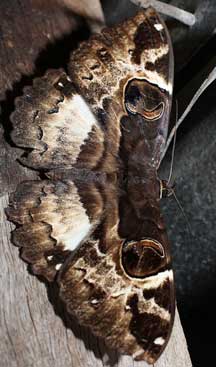
The Brown Hooded Owlet Moth is a fascinating nocturnal creature with unique features and behaviors.
Native to North America, these moths are known for their distinct coloration and wing pattern.
Their forewings display a mix of gray-brown, red-brown, or light yellow-brown hues with a design of smooth lines and spots, which can vary depending on their location.
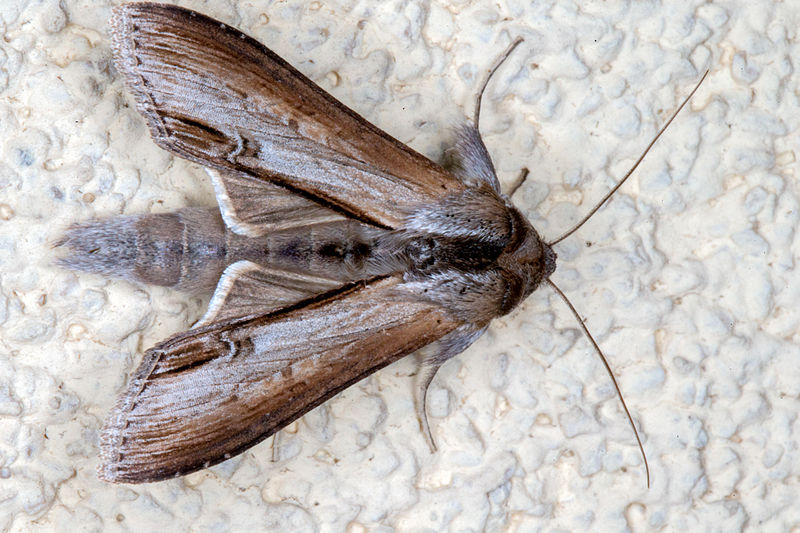
Source: Jerzy Strzelecki, CC BY-SA 3.0, via Wikimedia Commons
They have a forewing length of 15 to 20 millimeters, making them quite easy to spot when they’re drawn towards lights or sugar baits.
As nocturnal insects, these moths play a vital role in pollination and ecosystem balance.
They are primarily active during the night, using their antennae to navigate and locate sources of food.
Additionally, the Brown Hooded Owlet Moth has a unique life cycle involving four developmental stages: egg, larva, pupa, and adult.
This fascinating moth is not only a captivating species to observe but also a reminder of the important roles insects play in our environment.
Basic Information
Taxonomy
- Kingdom: Animalia
- Phylum: Arthropoda
- Class: Insecta
- Order: Lepidoptera
- Family: Noctuidae
- Genus: Cucullia
- Species: C. convexipennis
Scientific Name
The Brown Hooded Owlet moth is scientifically known as Cucullia convexipennis. It was first described by Augustus Radcliffe Grote and Coleman Townsend Robinson.
This moth species belongs to the Noctuidae family, which is a part of the Lepidoptera order in the Insecta class. The Brown Hooded Owlet is a member of the genus Cucullia.
Characteristics of the Brown Hooded Owlet moth:
- Gray-brown, red-brown, or light yellow-brown forewings
- Smooth lines and spots on wings
- Two times as long as wide wings
In comparison to other moths, such as the Spongy Moth, the Brown Hooded Owlet has a more significant variability in coloration and a smaller wingspan.
The Spongy Moth has a wingspan of 1-1/2 to 2 inches, while the Brown Hooded Owlet has a wingspan of 15 to 20 millimeters.
| Feature | Brown Hooded Owlet | Spongy Moth |
|---|---|---|
| Wingspan | 15 to 20 mm | 1-1/2 to 2 inches |
| Coloration | Variable | Male: brown with darker brown pattern; Female: nearly white with dark saw-toothed pattern |
| Flight Capability | Both male and female can fly | Only male can fly; female lacks flight capability |
Physical Characteristics
Adult Moth
The adult Brown Hooded Owlet Moth (Cucullia convexipennis) is characterized by a mohawk-like appearance.
The moth has long, whitish hairs with brown tips all over its head. This “hood” resembles a mohawk hairstyle.
The moth is a light brown color, but the outermost, lower edges of the forewings darken.

Source: Andy Reago & Chrissy McClarren, CC BY 2.0, via Wikimedia Commons
When the wings are open, the color is pale brown, but it gradually shifts to a darker tone near the edge.
When the wings are closed, the brown borders remain sharply visible.
The moth has a wingspan of 40–50 mm and the length of the forewings is 15–20 mm.
Caterpillar
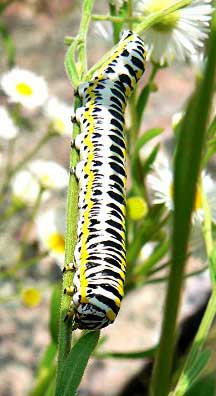
The Brown Hooded Owlet Moth caterpillar is also commonly referred to as the “Brown-bordered Cucullia.”
Unlike the adult moth, the caterpillar has quite a colorful appearance.

Brown Hooded Owlet Moth Caterpillar
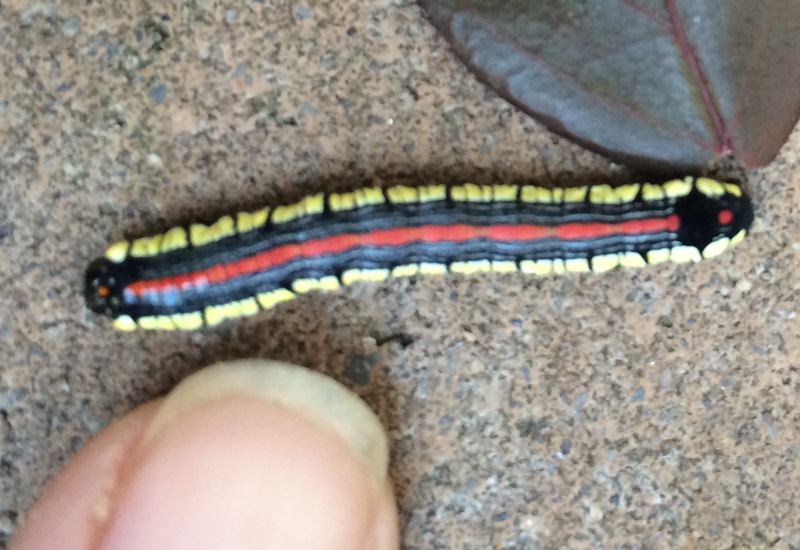
Its most prominent feature is the deep orange line that runs down the length of its body.
Combined with yellow and black markings, the caterpillar’s overall appearance is striking and often compared to a “Calico Paint.”
- Color: Colorful with deep orange line
- Common Name: Brown-bordered Cucullia, Calico Paint caterpillar
Life Cycle and Behavior
Eggs
The Brown Hooded Owlet Moth’s life cycle begins with the female laying small batches of eggs on the underside of leaves.
Their preferred host plants include:
- Willows
- Poplars
- Birches
The eggs will hatch into caterpillars within approximately one to two weeks, depending on environmental factors and temperature.
Larva
Once hatched, the larval stage, also known as caterpillars or Brown Hooded Owlet caterpillars, begins. They have unique features like:
- Colorful appearance
- Orange line through the middle
The aterpillars feed on the leaves of their host plants for several weeks.
Eventually, they will enter the pupal stage, forming a cocoon within which they will metamorphose into adult moths.
Adult Moth
Adult Brown Hooded Owlet Moths have a rather short lifespan. Key characteristics of this stage include:
- Dark brown-gray body
- White-bordered forewings
- Approximately 15-20 mm in length
As nocturnal creatures, Night-flying Brown Hooded Owlet Moths are attracted to lights and are active during the warmer months of the year.
Mating, egg-laying, and the end of their life cycle occur during this season.
The moths’ primary activity during their brief adult life consists of reproducing and seeking out their favorite host plants to lay their eggs.
Host Plants and Feeding
Preferred Plants
The Brown Hooded Owlet Moth primarily feeds on host plants such as goldenrod and asters. These wildflowers are essential for the moth’s larval development.
- Goldenrod: A popular choice for the Brown Hooded Owlet Moth, as it provides ample foliage for the larvae to consume.
- Asters: Another favored host plant, offering excellent nutrition for the developing larvae.
The Brown Hooded Owlet Moth is selective regarding its host plants.
However, they may occasionally feed on other wildflowers that are found within their habitat.
Habitat and Distribution
Geographical Range
The Brown Hooded Owlet Moth, known for its distinct appearance, has a distribution stretching across North America.
It can be found in the United States and Canada, inhabiting a wide range of habitats, such as:
- Forests
- Grasslands
- Gardens

Source: Flickr, Username: Seabrooke Leckie
The moth thrives in these diverse environments, where it feeds on a variety of host plants. Some examples of these plants include:
- Goldenrod (Solidago species)
- Asters (Aster species)
- Fleabane (Erigeron species)
In different regions, the Brown Hooded Owlet Moth may have specific habitat preferences, which could influence its local distribution.
However, overall, the moth is quite adaptable and capable of living in various environments throughout its range in North America.
Threats and Predators
Common Threats
The Brown Hooded Owlet Moth faces various threats in its environment. Some key factors are:
- Predators: Natural predators of this moth species include birds, bats, and spiders.
- Parasites: Parasitic wasps and tachinid flies can attack the caterpillars, laying eggs inside them.
- Environmental factors: Harsh weather conditions, such as extreme temperatures and heavy rain, can directly affect their survival rate.
Brown Hooded Owlet Moths maintain a balance within their ecosystem through their role as prey for many predators.
Conclusion
The Brown Hooded Owlet Moth, scientifically termed as Cucullia convexipennis, is a nocturnal marvel native to North America.
With its distinctive brown hues and unique wing patterns, it stands out in the moth world.
As a member of the Noctuidae family, it plays a crucial role in pollination, ensuring ecological balance.
Its life cycle, spanning from egg to adult, is a testament to nature’s wonders.
Despite facing threats from predators and environmental factors, this moth continues to thrive, showcasing its resilience.
Delving into its world not only offers insights into its existence but also underscores the significance of every creature in our ecosystem.
Footnotes


 l
l


 |
 |
| Brown Hooded Owlet Caterpillar | Unicorn Caterpillar |