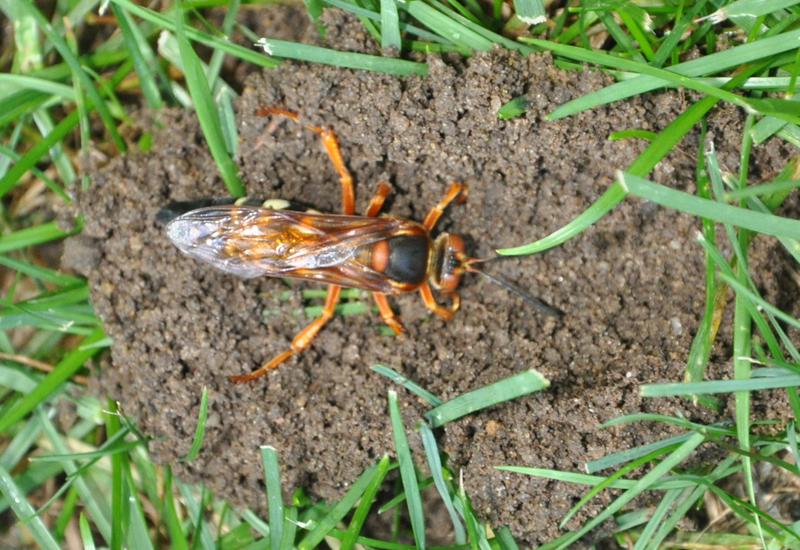
Cicada killers are much maligned wasps, primarily because of their similarity to Japanese hornets, the so-called “murder hornets” from Asia. In this blog, we look at the differences between the two species.
The Asian Giant hornet, more recently known as the Northern Giant hornet, is a name not many people will be fond of.
In 2019, this wasp was reportedly seen in Washington, United States, and British Colombia and it has created a huge scare in America ever since.
This wasp is also known as the ‘murder hornet’ because of its dangerous nature. More than 50 people have been killed by the sting of this killer wasp.
Unfortunately, people often mistake these hornets as Cicada killers and try to get rid of them instead.
So, what do you need to know about identifying these wasps, and how dangerous can they be? Let us help you find out.


Comparing Murder Hornet vs Cicada Killer
It is common to confuse Cicada Killers and Murder Hornets because of their appearance. Both these species have some similarities if you look at them from a distance.
But they can be recognized by their stripes and color, in some cases, their shape. Here are some things you have to look out for.
Color of their stripes
When you are trying to tell a murder hornet apart from a Cicada killer, look for the stripes on their body. Cicada killers will have uneven yellow stripes, jagged in places.
The Asian giant hornet will have darker stripes that are brown or orange. For these insects, the stripes will be smoother and denser across their abdomen.
Shape of stripes
Stripes of wasps are usually a major indication of what species they are.
In Asian murder hornets, their stripes will be in the form of smooth yellow bands evenly distributed across their body. Moreover, they have orange heads.
The Cicada killers will have yellow stripes that peak across their abdomen in uneven patterns.

Size
Both species of wasps are quite big compared to other cousins of their family. This is one of the biggest reasons why they are confused for each other.
Typically, however, the Asian giant hornet would win the contest if the length was the only parameter. Not for nothing are they called giants because they can grow to be as long as 2 inches.
Cicada killers are also quite big, but usually, they do not exceed 1.5 inches in size.
Habitat & Season
Cicada killers build their nests underground, where there is well-drained soil available. These wasps try to find a place where there are high cicada populations around trees.
Murder hornets, on the other hand, will build nests in abandoned burrows of small animals, mostly near decaying roots of plants and trees.
The murder hornets build their nests and mate at the start of summer in March and April. Cicada killers have their breeding season in the mid-summer months of July to August.

Behavior
Female cicada killers are solitary insects who are extremely alert about their nests. These species do not have a queen or other worker insects. The males do not have a sting, but they can display aggressive behavior.
Murder hornets are social insects that live in large colonies. Their nests consist of workers, drones, and a queen. Each of them has a role to play in their colonies.
Threat Level
Cicada killers are called so because of their food source, which mainly consists of Cicadas.
They use their sting to paralyze their prey, taking them away from the larvae in the nest. They are not a threat to people or other insects unless someone mishandles them.
Murder hornets, on the other hand, are extremely aggressive and dangerous stinging insects. They are very protective of their nests and are sure to leave a painful sting o anything coming close to them.
They have quarter-inch-long stingers that can penetrate through any kind of protective clothing. These insects have also become infamous for decimating the population of honey bees.
Where They Are Found in the US?
Cicada Killers are usually found in areas that have a large number of cicada populations. This is a native wasp of the United States.
These insects can be found in the eastern states, usually east of the Rocky mountains. A genus of this species in the Western states is also referred to as Western Cicada killers.
Murder hornets were not found in the US till as recently as 2019. Two of these hornets were first discovered in Northwest Washington states, which led to a colony in British Colombia. This was destroyed, given the dangerous nature of the hornets.
No further verified sightings have since been reported.

How To Prevent Attacks?
Cicada hornets are usually not that much of a threat to you. These solitary wasps will only get aggressive with you if you try to harm their nests.
You can prevent the growth of their nests by letting the grass grow out and keeping the soil damp.
Murder hornets have not been officially established as a species in the US. It is recommended to notify the sightings at the Washington State Department of Agriculture.
And if you can identify one, try to run away as far as possible from them.
Frequently Asked Questions
Will cicada killers sting humans?
Cicada killers are often called the ‘gentle giants of the insect world.’ These are just like common species of solitary wasps, which may appear intimidating but do not harm humans in any way. However, female wasps might attack any creature that tries to harm their nests.
Does Japan have cicada killers?
Cicada killers are usually found in parts of North America and British Colombia. Though there is not much known about these insects in Japan.
The murder hornets are called Japanese Giant Hornets because they are common in Asian countries.
Are cicada killers aggressive?
Cicada killers are not aggressive by nature. These insects keep to themselves and are not likely to harm humans or any other insects except cicadas.
These wasps can become aggressive only when they sense a threat to their nests.
What attracts cicada killers to your yard?
Cicada killers look for areas that have sandy areas and scattered lawns that are easy to burrow.
They usually look for creaks on windows and sidewalks where they can settle in to lay eggs. These insects are also attracted to areas that have a high population of cicadas.

Wrap Up
Whether they are insects hunting cicadas or huge hornets that do not tolerate interference, the best idea is to get away from them if you come across one.
And if you can recognize a murder hornet, do not think one minute before trying to flee for cover. Thank you for reading!